Get updates from The Developer straight to your inbox Yes, please!




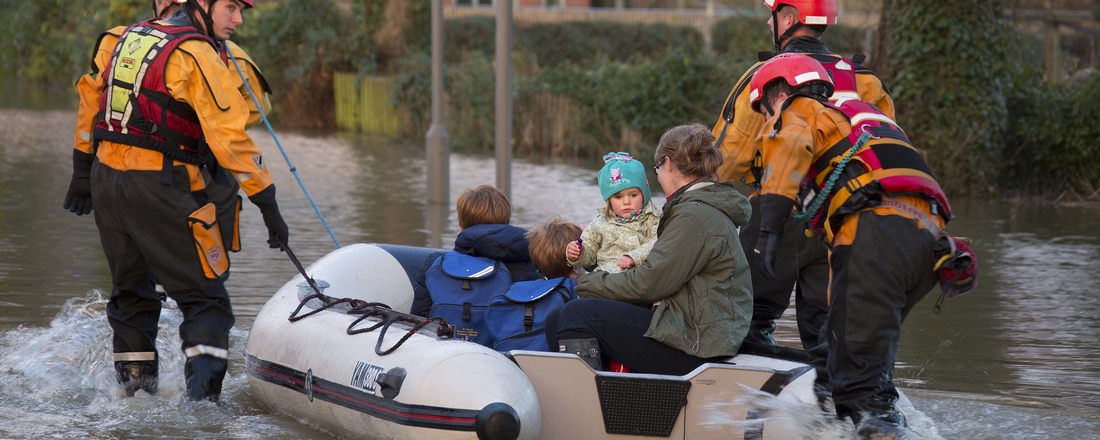
“If you’ve never flooded, you don’t realise that the water is filthy”
The average flood damage in the UK is 0.3m, barely up to the shins in terms of water, but that can still mean thousands of pounds in damage. Peter Apps reports on the growing issue of flood poverty


Pete Apps is a journalist and author of the Orwell Prize-winning book Show Me The Bodies which covers the build up to the Grenfell Tower
......Pete Apps is a journalist and author of the Orwell Prize-winning book Show Me The Bodies which covers the build up to the Grenfell Tower
......“We have the idea of being in food poverty and fuel poverty,” says Kerry Halfpenny, a flooding consultant and building surveyor. “But we really need to add another ‘F’ to that list – for flood poverty.”
We all know that flooding is a growing risk to the UK. The weather is getting wetter, windier and wilder which means more frequent bursts of intense rainfall and more water in our rivers. The most recent figures from the Environment Agency say 6.3m homes are at risk of flooding – a figure that will rise to 8m by 2050.
What is less well understood is the way this links with poverty: Poorer people are both more likely to be flooded and will be impacted more seriously when they are.
“Recent government policy documents specifically say that combatting the disproportionate impact on deprived communities is one of three key priority areas for flooding policy,” says Paul Cobbing MBE, a flood consultant and former chief executive of the National Flood Forum, referring to proposed changes to the funding formula for flood-risk communities.
“Flooding has a differential impact on people who are already experiencing disadvantage,” says Cobbing. This disadvantage is backed into the system before the water even arrives.
If anything gets into that water, it’s contaminated and probably needs to be destroyed: Beds, rugs, mattresses, furniture, clothes
It is not as straightforward as saying that deprived communities are more likely to be flooded. As research by the Resolution Foundation explains, the country’s very poorest neighbourhoods are typically found in cities, where the flood risks are lower. But within a particular town or area that does have a high flood risk, it is often the areas of highest deprivation where the risk will be most extreme. This is for the simple and depressing reason that heightened flood risk means lower rent or house prices, and poorer people have the least choice.
“If you think of an area like Rossendale [a Lancashire district highly vulnerable to flooding], there are a lot of the more affordable homes built at the bottom of the valley,” says Tracey Garrett, chief executive of the National Flood Forum. “Those homes, now, are where some people on lower incomes might live and they are right in the front line if the river floods.”
Another area like this is Rochdale, in Greater Manchester. “The impact of flooding in Rochdale is not distributed evenly,” concluded a March 2024 report prepared for Rochdale Council. “High flood risk areas in Rochdale often have high Indices of Multiple Deprivation (IMD) populations partly because housing is relatively cheap for both homeowners and tenants.”
It also appears that deprived areas are less well defended. Research for Friends of the Earth identified 2,974 socially vulnerable neighbourhoods in England at risk of flooding and likely to be without flood defences.
When a flood does hit, poorer people are likely to be harder hit. The worst place to live in a flood is a basement flat, where the risk of death will be most heightened. Where these are available in cities like London, they will often be at the bottom end of the rental market.
It is often the areas of highest deprivation where the flood risk will be most extreme
Even where we are not talking about basement flats, poorer people are more likely to live in homes with general maintenance issues, which can increase the damage from flooding. “When flooding occurs, many houses are vulnerable because of poor build and maintenance,” says Cobbing. Gaps around windows and doors, existing leaks, poor plumbing…. All of these can make the water damage from a flood worse.
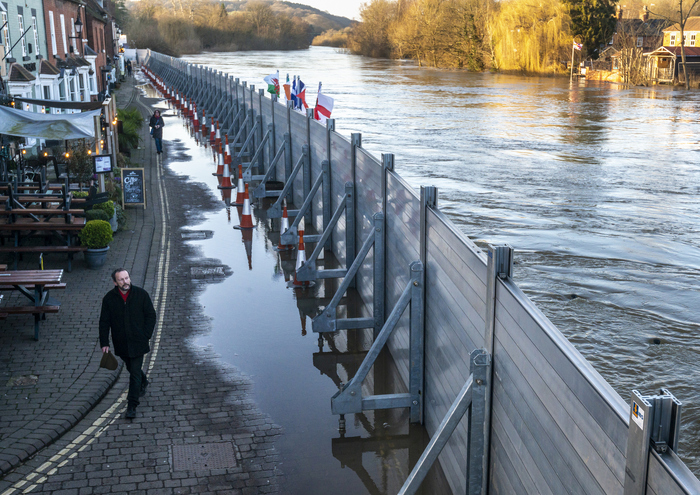
Poorer communities also face a much bigger struggle to make their properties more flood resilient. Flood doors, barriers, pumps, flood-resilient flooring: All of these can make a major difference to the scale of the damage, but all of them are costly – requiring surveys, specialist installation and maintenance.
Some support is available for this work, but it is neither means-tested nor targeted towards disadvantaged groups – for example, there was a £5,000 grant scheme available for households to make their properties more flood resilient which closed in 2023. But the cost of flood resilience measures meant it served as a handy top-up for middle-income households with little practical use to those on lower incomes.
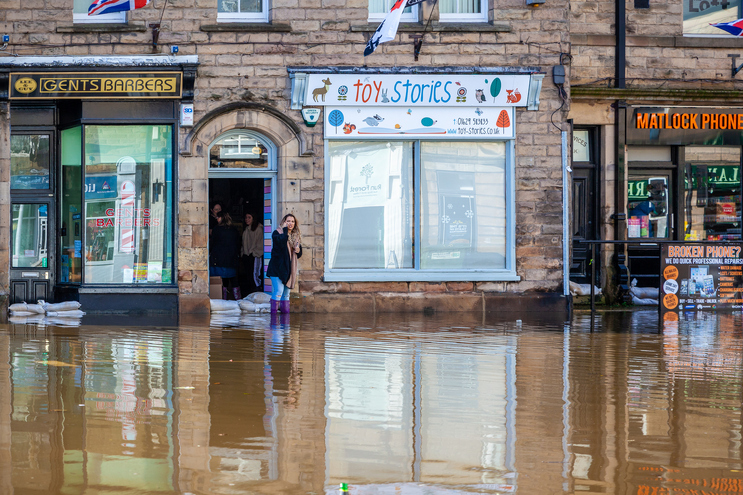
“Why wasn’t it means tested?” says Halfpenny. “The cost of the very basic measures you need to put in and all the surveys will be way above £5,000. If you can’t afford to top it up, the grant won’t do you any good.”
Then there is the Build Back Better scheme – a £10,000 top up from insurance providers to install flood-resilience measures to households when repairing their properties after a flood. This is discretionary: Halfpenny says the lower income communities she works with have not benefitted from it.
“Not one person I work with in Calderdale has been given build back better funding. I wonder if the insurance companies aren’t offering it in our area, because we’ve flooded so many times before? But there are houses in affluent areas down in the south of England that are getting this money,” she says.
Some of the advice about coping with flooding, Halfpenny adds, does not take into account people’s limited means. For example, a good deal of guidance recommends against using sandbags and tells people to install fully waterproof flood barriers instead. For poorer households, this isn’t an option.
Some landlords out there are really conscientious and do their best, but there are landlords out there who just don’t care
There are some cost-effective measures which poorer households could look to employ. Flooding campaigner Mary Long-Dhonau OBE - widely known as Flood Mary - travels the country giving practical advice to households living in flood risk areas.
“Before a flood, all your valuable possessions, things you’re sentimentally attached to should go in plastic boxes and be put upstairs. You can put plastic buckets or wellington boots around the legs of chairs and tables,” she says.
But even these lower cost solutions are harder for poorer communities. Long-Dhonau recalls speaking to a group of tenants in Warrington about aluminium tape which costs around £15 a roll and can be a good way to seal up air bricks.
“I was talking to some people that lived in social housing about this, and three of them said ‘we could club together to get a roll of that tape, couldn’t we?’,” she says. “And it really hit me in the stomach that even a £15 solution people were having to club together to buy.”
This means that poorer people are first more likely to live in flood risk areas, to occupy properties vulnerable to flooding and to be less able to upgrade them to make them resilient.
It is after a flood hits when deprivation can really bite. If you rent your home, the aftermath of a flood means dealing with your landlord. And this can, to put it mildly, be a mixed experience.
“Some landlords out there are really conscientious and do their best, but there are landlords out there who just don’t care, and sometimes people don’t even know who their landlord actually is,” says Garrett.
“You do hear of landlords simply refusing to do anything,” says Mr Cobbing. “So tenants are left in houses that are damp, moldy and so on, and because of the housing pressures that there are, tenants can’t move. So they’re just desperate for somewhere dry to live.”
A good example of this is Sarah*. Sarah did not experience river or rainfall flooding, instead a pipe in the flat above in her housing association-owned block in the midlands burst, sending a torrent of raw sewage gushing up from her shower plug and deluging her property.
It took days for the landlord to decant her to a hotel, and since then she has endured years of homelessness, including 10 months of rough sleeping. She moves between hotels and Airbnbs, as her landlord consistently promises that the property is safe and repaired and tells her to return home.
Even where landlords do try, they may not have the specialist knowledge required. Drying a property out is very difficult, very specific work
Each time, Sarah has found the flat contaminated, filthy and stinking of sewage. In one instance, so much water had accumulated behind the door that it could barely be opened and came rushing out once her partner eventually forced it.
“I have never smelled anything like it in my life, it was like walking into a slaughterhouse in the height of summer,” she recalls. “I was trying so hard to survive, trying so hard to get the council to step in, to get my landlord to fulfil their duties, but you could not penetrate through that cold, corporate barrier.”
While Sarah’s experience with her landlord may be at the extreme end, it is not uncommon. Even where landlords try to act in good faith, they do not always understand the complexity of drying out and repairing a flood-hit property. Full restoration costs between £10,000 and £50,000 (or more) depending on the size of the property and the extent of the damage. Many landlords will seek cheaper solutions which may not be appropriate.
“Even where landlords do try, they may not have the specialist knowledge required. Drying a property out is very difficult, very specific work,” says Garrett.
The next – big – problem is insurance. Not everyone has basic building insurance. Properties built after 2009 do not benefit from reduced premiums via ‘Flood Re’, and neither do landlords. In flood risk areas, this means premiums can be very high and are sometimes avoided.
Even where a landlord does have building insurance, contents insurance is separate, and tenants are typically very unlikely to have a policy, especially if they are financially stretched. “Tenants who are living in poverty won’t have contents insurance, there’s absolutely no chance,” says Halfpenny.
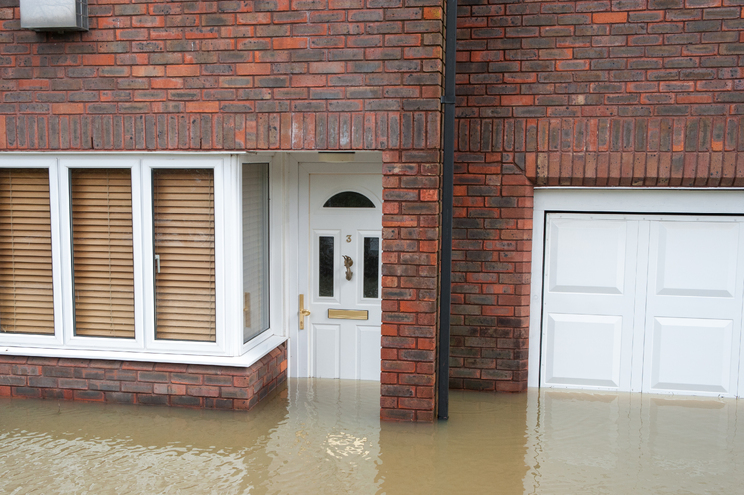
After a flood, this can be devastating. The average flood damage in the UK is 0.3m, barely up to the shins in terms of water, but that can still mean thousands of pounds worth of possessions need to be replaced.
“If you’ve never flooded, you don’t realise that the water is filthy,” says Garrett. “It often contains sewage, it’s vile stuff. If anything gets into that water, it’s contaminated and probably needs to be destroyed: beds, rugs, mattresses, furniture, clothes.
“After a flood, condensation will be dripping off the ceiling and the stench gets into everything, even if it somehow doesn’t get wet. A pretty normal scenario is that you need to replace all your possessions and that is a terrifying prospect if you don’t have insurance.”
What this will mean for poorer households is increased poverty, either due to the debt taken on to buy replacement goods or simply because of the increase in relative poverty
When widespread flooding happens and more than 50 properties flood in a county, emergency flood resilience funding can be released to the local authority which offers grants of around £5,000 to impacted households, but often no more than £500.
This is a drop in the ocean for the poorest households, who will be utterly destitute. In more localised flooding instances, the funding is not triggered at all.
“No matter how many houses have been impacted, people’s lives are wrecked by flooding. And the grants should be triggered automatically after any flood,” says Long-Dhonau.
What this will mean for poorer households is increased poverty, either due to the debt taken on to buy replacement goods or simply because of the increase in relative poverty that will follow a flood when families go without basic goods.
And this isn’t the only expense. “People may have to take time off work, they will be dealing with contractors, they may end up paying for their own temporary housing or being in temporary housing might add other costs like food and taxis,” says Garrett. “It all adds up very, very fast.”
And then there are the health problems that follow flooding, always made worse if the property is not properly dealt with.
“There’s lots of respiratory illnesses,” adds Garrett. “There’s clear research which shows people are at risk of PTSD after flooding. If people flood repeatedly the chances of that go up exponentially. People suffer from rheumatism and arthritis, people have heart attacks. These can’t always be linked to the flooding, but there’s clearly a correlation.”
We’re building houses willy nilly with no regard to the fact that the people buying it might not be able to get flood insurance
What could we be doing to make this easier? Long-Dhonau says landlords, particularly social landlords, could be investing much more in making their tenants’ homes flood resilient.
“Landlords could be proactive and if they’re aware a flood is going to come to the area, they could provide an easy-fit flood barrier in front of the house,” she says. “A self-closing airbrick [a ventilated brick designed to let air circulate in a home] costs £50. In a flood, five cubic metres of water an hour can get through an air brick, so that money will be repay itself massively in terms of the cost of remediating the home and providing temporary accommodation.”
She also thinks the government should be much more cautious about building homes in high flood risk areas and failing to include good rules on flood resilience in building regulations.
“We’re building houses willy nilly with no regard to the fact that the people buying it might not be able to get flood insurance,” she says. “You cannot build a house to flood. You cannot do that. It’s criminal in my book.”
Again, there is a poverty element here. New buyers might avoid these homes. Those on a social housing waiting list will simply be allocated to them.
The new NPPF did actually tighten rules on flooding - requiring consideration of all types of flooding risk, as opposed to just river and tidal, as well as looking for more opportunities to improve green space and other infrastructure to reduce flood risk on new sites and elsewhere.
But with the pressure to build new homes mounting up and developers given the backing of government to ‘build, baby, build’, the reality is less flood-safe. Analysis suggests 100,000 homes will be built on the highest risk flood zones in the next five years.
“It can break people being flooded,” adds Long-Dhonau.
“I recently met a couple whose bungalow had flooded while they were staying with their daughter. Both of them were 89, she was on a Zimmer frame. He said to me, ‘I’m 89 and we lost absolutely every possession in our home. And now we know we’re not much longer for this earth, my dear. But when we die, there will be no record that we ever lived because we’re leaving nothing behind’. And he started to cry, and she started to cry, and the only thing I could do was cry along with them.”
Peter Apps is an award-winning journalist and author of books, Show Me the Bodies: How we let Grenfell happen and Homesick: How Housing Broke London and How to Fix It.
If you love what we do, support us
Ask your organisation to become a member, buy tickets to our events or support us on Patreon
Sign up to our newsletter
Get updates from The Developer straight to your inbox
Thanks to our organisation members
© Festival of Place - Tweak Ltd., 124 City Road, London, EC1V 2NX. Tel: 020 3326 7238