Get updates from The Developer straight to your inbox Yes, please!





“A broken model”: The viability loophole and its impact on affordable housing
The Aylesham Centre project, like many in London, has reduced its provision of affordable homes. Scratch beneath the surface, and it points to the frailty of a viability-led planning system that poses a major risk to the future supply of affordable housing, Peter Apps reports


Pete Apps is a journalist and author of the Orwell Prize-winning book Show Me The Bodies which covers the build up to the Grenfell Tower
......Pete Apps is a journalist and author of the Orwell Prize-winning book Show Me The Bodies which covers the build up to the Grenfell Tower
......The small shopping arcade feels like it’s underwater. Blue meshed sheets under the domed glass ceiling, apparently there due to a risk of falling debris, dim the light. There is an irony here, because the Aylesham Centre is in danger of drowning.
The centre is a covered public walkway at the mouth of Peckham’s Rye Lane. There are shops on either side and small carts in the middle, mocked up in cream and blue to look like something from a postcard seaside promenade, where local traders sell popcorn, slushies; eyebrow threading, African cloth and herbal teas.
There is a Clarks shoes outlet selling last season’s styles at cutdown prices, a Poundland, a fruit and veg shop fronted by overflowing crates of cassava, yams and plantain and a Morrisons supermarket.
Crucial, though, is the way this small walkway links a big car park to the famous south London high street. “Traders round here are really just surviving,” explains Siobhan McCarthy, a local resident and a member of the Aylesham Community Action campaign.
“The centre is crucial, because people drive in from all round south London and even Kent to come and do their shopping here. People might have left Peckham, but they keep coming back here and that keeps it alive. If you cut this off, the whole street could die.”
“We are not against development… This is just the wrong plan for the area. People in Peckham need affordable housing”
Rye Lane is a hub of the capital’s south London Afro-Caribbean community, and remains a mishmash of working class Black culture, despite the rapid gentrification of the area.
There are stores that sell beauty products, African butchers and fishmongers, cash and carries, charity shops, pubs, cafes and the Peckhamplex, an independent cinema where you can see movies for £4.99.
A place like this remains the real heart of London: a crowded, narrow street, with its smells of fried food and vapes, music banging from various shop fronts and double decker buses vying for space with Lime bikes, delivery drivers, and the pedestrians who dodge between them as they crisscross the street to get from one shop to another.
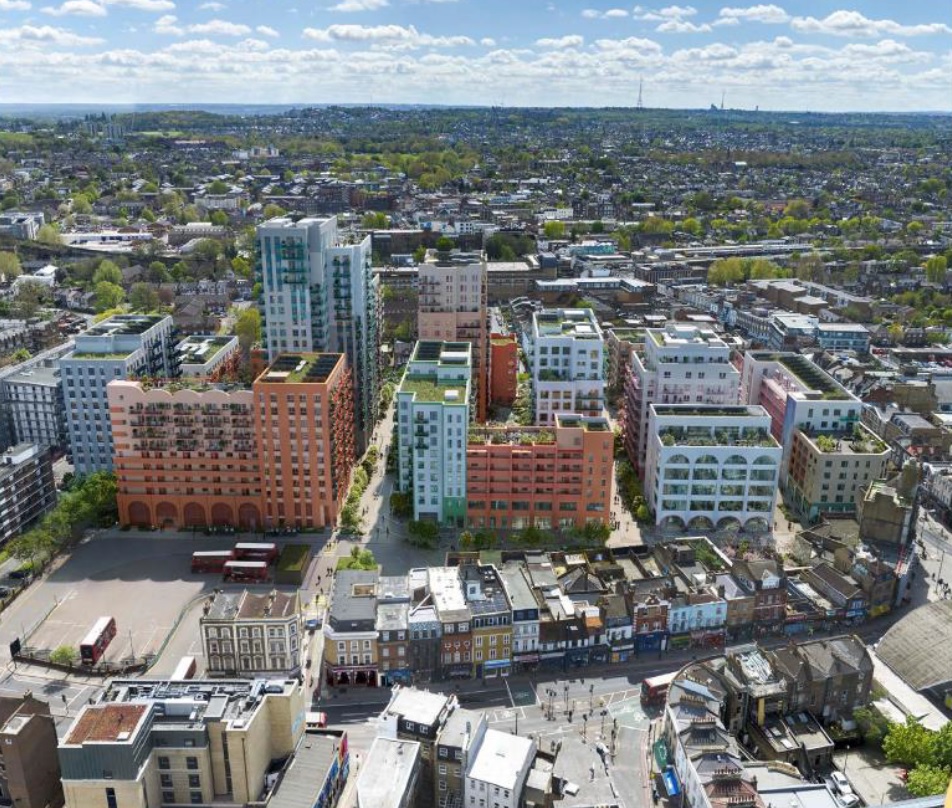
But the Aylesham Centre’s days may be numbered. Berkeley Homes, one of London’s major developers of new housing, has submitted plans to turn the car park and shopping centre into 867 flats.
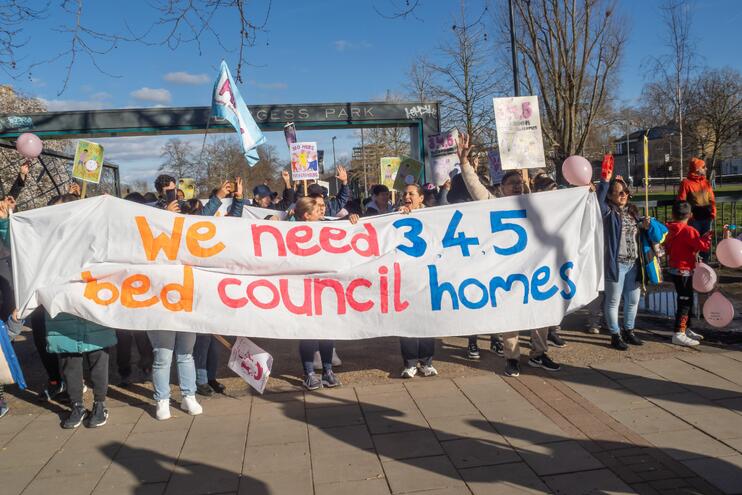
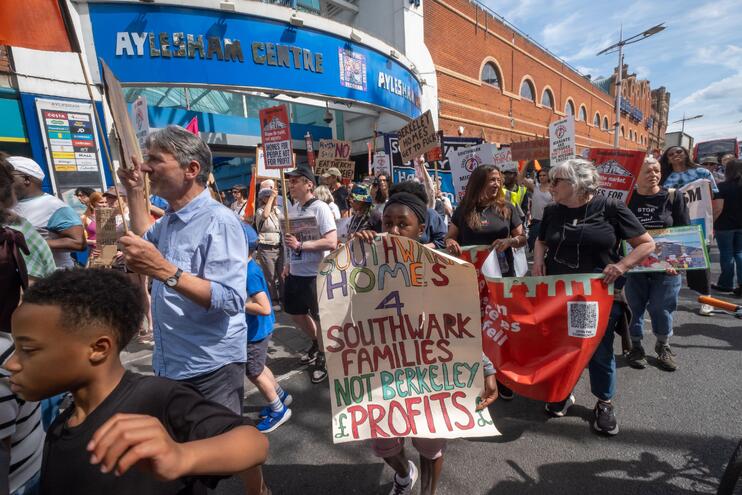
A local campaign has sprung up in opposition, and the centre has become the latest front in London’s battle between local communities, activists and property developers.
At the heart of this fight are questions about who London is for, how it should develop and how we should balance the need for more housing against an existing community’s aspirations for its area.
The Aylesham Centre plans have been in the works for a while. The land was previously a famous Jones and Higgins department store, which opened on the corner of Rye Lane in 1867, as part of a ‘golden mile’ shopping district intended to rival Oxford Street.
Jones and Higgins closed in 1980, and part of the historic building was demolished to build the Aylesham Centre.
The site was earmarked for housing development in 2014, and sold to a consortium of BlackRock and Tiger, two giant American investment firms. The investors drew up plans for a residential development, but never brought them forward, instead selling the site to Berkeley in May 2021.
In May 2024, Berkeley put forward plans for the 867-home development with 35% affordable housing, promising to rebuild the Morrisons supermarket as part of its plans. The fate of the rest of the traders on the site is unclear.
But then, in January 2025, in a move which has upset locals and sparked objections from council and the local MP, Berkeley said its offer of 35% affordable housing was no longer viable and applied to cut the rate to 12%. This would mean 50 socially rented flats and 27 for intermediate rent, with remaining 790 properties for outright market sale.
“We are not against development,” says Siobhan. “This is just the wrong plan for the area. People in Peckham need affordable housing - no one from around here is going to be able to get close to affording one of those flats.”
Berkeley said its offer of 35% affordable housing was no longer viable and applied to cut the rate to 12%. This would mean 50 socially rented flats and 27 for intermediate rent, with 790 properties for market sale
Berkeley projects a value of £850 per square foot for these flats, which means it expects to sell an apartment of average size for more than £600,000. This means a buyer would need a £60,000 cash deposit and an income of £120,000 to get one. The average income in Peckham is £34,100 a year and there are 4,000 residents from the area on the waiting list for a social home, and more than 18,000 across Southwark as a whole.
Market sale homes are open to anyone who can afford to buy them, but this is more likely to be people from outside the immediate area. At a community meeting in April 2024, representatives from Berkeley were asked who they expected to buy one of the flats. The answer, to loud jeers from the various community members present, was “people looking for a second home in Peckham”.
Residents are also concerned about what they call the “over-development” of the scheme, arguing that such a high density of new homes would not be accepted in a more middle-class area.
Indeed, campaigners point to the fact that the development had to take account of the impact on the ‘conservation area’, but not the parts of the community that are important to them.
“I think the people in charge of planning at a national level have got very little respect for working class communities,” adds Tanya Murat, a long-time housing campaigner from south London. “A development of this scale and density would not be tolerated in a more affluent community. Working class communities are not given a say in shaping their area or the kind of development they want. We just get designs imposed on us. The planning system only cares about preserving heritage in wealthier places.”
If there were more affordable housing, the benefit to the local community would be much clearer and less opposition likely. So why is Berkeley only offering 12%? Financially, the housebuilder reported a pre-tax profit of £557m in 2024, against income of £2.4bn – a healthy profit margin of 23%. This may be substantially down from the dizzy heights of 2018, when it made £935m profit from £2.7bn of income, at a margin of 34%, but the numbers make it easy to sympathise with the residents’ view that paying for more social housing is viable.
Berkeley’s viability assessment would have supported 0% affordable housing – it believes its offer of 12% is generous
For its part, Berkeley blamed “rising costs exacerbated by the length of the planning process” when it notified Southwark Council of its plans to reduce the amount of affordable housing in December and has submitted an appeal against the “non-determination” of the plans, which are still awaiting approval.
Southwark Council, meanwhile, has said it is “very disappointed” by Berkeley’s actions, insisting it met the required timetables for approval, and only re-consulted only when the proposed affordable housing numbers were cut. So who is right?
The truth appears to be that the scheme, like many in London, is currently caught in economic headwinds which pose a major risk to the city’s future supply of affordable housing. When Sadiq Khan took over as mayor in 2016, he introduced a planning fast track: if a builder agreed to 35% affordable housing, they could obtain permission without needing to submit a viability assessment.
This kept a reasonable number of affordable homes ticking through for a while, but in recent years things have changed. Costs have risen, while a slowing sales market has lowered profits. This means that the calculations – under which developers are allowed to account for a reasonable profit (usually between 15% and 20%) – result in much lower affordable housing numbers, and developers see less benefit in taking the 35% route.
“The fast-track route in London resulted in a number of planning consents with 35% affordable housing on paper that ultimately aren’t deliverable,” explains Matthew Haycox, head of affordable housing development consultancy at JLL. “What we’ve seen recently is developers being much more prepared to take on the viability challenge and go back to local authorities to negotiate a compromise to get homes of all tenures delivered.”
“There’s far less off plan activity than there was 10 years ago… that market has changed, and most schemes probably won’t sell more than 15% or 20% of homes more than two years off plan”
This is reflected in three high profile appeal decisions, where planning inspectors approved schemes at Stag Brewery (Richmond), Cuba Street (Canary Wharf) and West Ealing with affordable housing provisions of between 7-20%.
Indeed, Berkeley’s viability assessment would have supported 0% affordable housing – it believes its offer of 12% is generous.
“Viability plans for local areas were set when the sales market was in a very different place,” adds Marcus Dixon, director of UK Residential Research, also at JLL.
“It’s currently ticking over, but it certainly isn’t going all guns blazing. And at the same time, a lot of other costs are going up: material prices, labour costs, contractor defaults, the cost of finance. All these things have been pushing build costs up, and that’s before we even get to new regulations on building safety and the delays that process can impose.”
Scratch beneath the surface though, and what you find is a broken model that was arguably never doing much to alleviate London’s housing crisis.
One of the major changes between now and 10 years ago is the reduction in “off-plan” sales - where investors buy a property years before the development is completed, to hold or trade as an investment.
“Over time we have moved towards a system of viability-led planning, so it’s become less about values and principles and more about introducing policies which are financially viable for developers to deliver”
“There’s far less off plan activity than there was 10 years ago,” he says. “Back then, builders would sell around 60% of their new homes two years or more in advance. An agent would take a suite in a hotel in Hong Kong and market them to investors. But that market has changed, and most schemes probably won’t sell more than 15% or 20% of homes more than two years off plan.”
International investment has changed, he explains, with other global cities competing with London, which was a world leader for attracting real estate capital. “Markets like Dubai have become more popular with overseas investors,” he says. “So too have places like Sydney and various cities in Canada. There is more choice for investors, so London isn’t the default choice it once was.”
But this seriously disrupts the development model and slows down the speed of building. If builders can sell less off-plan, they must sell more to regular buyers - either future residents, or small-time landlord investors adding to or building a portfolio.
This means cash comes in much more slowly than the up-front slug you could expect from off-plan sales, the development needs more debt. With the cost of financing rising, this too increases costs.
An even bigger impact is that it slows the rate at which schemes will be built. In the viability assessment submitted by Berkeley, the builder projects that it will take eight years to build out the site, with its construction of phase two (which includes the majority of the private housing) not beginning until 2030 and running through to 2034.
This isn’t because of planning or regulatory delays, but because it plans to only release six flats for sale per month, which is necessary to keep demand as hot as possible and prices high.
“The concept of viability fundamentally undermines the planning system and means it can’t deliver as it should”
The justification for this model - in terms of its contribution to fixing the housing crisis - has always been that it funds affordable housing. But with margins squeezed, that has now gone. So should we be looking to a new model altogether?
Doing so would require a big shift in emphasis in a planning system that currently serves mostly to enable viable development.
“Over time we have moved towards a system of viability-led planning, so it’s become less about values and principles and more about introducing policies which are financially viable for developers to deliver,” says Dr Jessica Ferm, an associate professor in the Bartlett School of Planning at University College London (UCL).
“I think this gets to the heart of the question, ‘what is planning there for?’ Is it there to protect and provide for public interest and make sure that we deliver certain outcomes or is it there to facilitate development? From the community perspective, planning officers are viewed as guardians of community and public interest, but they don’t really have that power.”
Viability entered into planning discourse when the coalition government introduced the National Planning Policy Framework in 2012: which barred local authorities from making requirements that would prevent a landowner and developer making “competitive returns” on development.
This has left planners in an invidious position: they are faced with the builders’ assessment of costs and profits, produced by a range of professional consultancies, with the threat that their decisions will be overruled on appeal if they say no, which can be ruinously expensive in legal fees.
In a report published this month, the National Audit Office said the system was “falling short”. “Developers can use financial assessments to contend that a site is not viable... These assessments are often hard for local authorities to challenge due to a lack of transparency, limited expertise, and the ability of larger developers to use consultants to reduce their contribution obligations,” the report said.
“The concept of viability fundamentally undermines the planning system and means it can’t deliver as it should,” says Bob Colenutt, a lecturer on planning at Oxford Brookes University. “The numbers that get put into local planning policies are completely meaningless when they can be overturned like this.”
With 44% of the country’s affordable housing being delivered through this route (as opposed to being directly funded by government grant) this is a major problem.
But the Labour government, in its promise to overhaul planning laws, is not willing to review viability testing amid concern that doing so would slow overall house building and damage its chances of achieving its target of 1.5m homes.
“I feel quite defeated at the moment. We’ve been saying it to Labour in opposition and in government, but they just haven’t heard it because the focus is just getting us to the magic 1.5m number, not to reform the system”
For Dr Tom Archer, a senior research fellow at Sheffield Hallam University, who has studied the business models of large house builders, the government’s target was a mistake because it effectively gives the developers an ability to hold the government to ransom.
“If you set a very large house-building target, this confers power on private developers whom we rely on for the vast majority of our new homes,” Archer says. “It creates a scenario where they are able to demand various policies to ensure the target is met. And yet, the logics of that market still remain, and they will continue to build at a rate and volume that maximises profitability. It is therefore questionable whether those policies will ever be enough to achieve the government’s ambitions.”
All of this creates a problem for developing sites like the Aylesham Centre, where questions about affordability and supporting and developing community facilities and infrastructure need to be imposed if the development is to be a success.
Yolande Barnes, a professor of real estate at UCL, says that we need new models of development altogether led by more patient investors and including those with a long-term interest in the community, such as a partnership between a local authority and a pension fund. This would open a door to funding real community infrastructure and affordable housing and taking the return on the benefits that creates over a much longer period.
“The current private developer model is not set up to deliver that sort of investment, because speculative housebuilders usually need an annual return on capital employed for shareholders,” she explains. “This works against ongoing ownership and stewardship of whole places where value is created over time by building community and adding to ‘place prosperity’. The way you have to fund this, plus infrastructure and amenities, is long term and different. We need to design new economic and business models before we design new buildings.”
“We were here before Berkeley, and we’ll still be here when they’ve gone. So we’re not just going to give up without a fight”
“We need to talk about who funds the bits of development that are ‘not the houses’, and how they fund it and over what period of time. And once you start asking that question, you get into much more interesting conversations about public sector masterplanning, and community land ownership,” adds another source who has had high level conversations with ministers about planning reform.
“The problem is when you’ve got a builder who has not got that long term interest in the site, you will never get that. We need institutional investors, and longer-term landowners - but the problem is they don’t own or have options on most of our land. So I feel quite defeated at the moment. We’ve been saying it to Labour in opposition and in government, but they just haven’t heard it because the focus is just getting us to the magic 1.5m number, not to reform the system.”
These are the debates that are currently swirling around the future of house building. A recent review of developing large sites, and the suggestion of hard demands for mixed tenures, suggests at least some in government are listening.
But for those local to this car park and small shopping centre in south London, the debate is more simple. They see a developer attempting to bleed profit out of their community without offering any benefits in return, and they are determined to fight.
“This is about the soul of London, the kind of city we’re building for the future, and who it is for,” Tanya says. “We were here before Berkeley, and we’ll still be here when they’ve gone. So we’re not just going to give up without a fight.”
A Berkeley Homes spokesperson said: “This is an underutilised town centre site, in a highly sustainable location, which has been allocated by Southwark for housing-led development since 2014, yet no redevelopment has taken place in over a decade.
“The proposal put forward by Berkeley in is line with Southwark’s site allocation and the joint development brief compiled with Southwark Council. The brief was prepared specifically with the aim of avoiding harm to the conservation area and neighbouring heritage assets.
“The application meets the requirements of the site allocation and the joint design brief; proposing 867 homes, a replacement supermarket for Morrisons, increased retail and commercial space and 2.5 acres of new public realm (equivalent to 39 tennis courts). The development would create over 270 construction stage jobs and 60 apprenticeships, alongside up to 660 permanent jobs and £15m of s106 and CIL contributions for investment in Southwark’s communities.
“The elapse of time has seen market conditions decline which has affected the viability of the project. This made it necessary for Berkeley to submit amendments to the planning application in December 2024. Despite the Council’s viability assessor agreeing that the site cannot afford to deliver any affordable housing, Berkeley has offered 12%, with all the social rented homes delivered in phase 1. This is a significant benefit alongside the CIL, s106, government taxation, great placemaking and local amenities, and importantly it ensures that the proposals will be deliverable.”
Peter Apps is an award-winning journalist and author of Show Me the Bodies: How we let Grenfell happen. The book was awarded the Orwell Prize for Political Writing in 2023. Apps is a contributing editor of Inside Housing
Find out more The route to Better Social Housing will be discussed at Festival of Place on 2 July alongside a full day of content on how to make healthier, more equitable places.
If you love what we do, support us
Ask your organisation to become a member, buy tickets to our events or support us on Patreon
Sign up to our newsletter
Get updates from The Developer straight to your inbox
Thanks to our organisation members
© Festival of Place - Tweak Ltd., 124 City Road, London, EC1V 2NX. Tel: 020 3326 7238