Get updates from The Developer straight to your inbox Yes, please!





Got flooding problems? Have you considered diverting the river?
Toronto has kickstarted its port renewal project with a riverine park that lifts 174 hectares out of the floodplain and makes ready for homes, Christine Murray reports


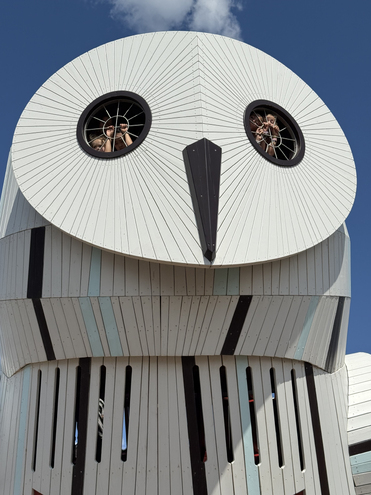
T he first thing I see is the snowy owl, a child in its vacant eyes. The 9m-tall white timber fowl and its companion, a raccoon, are the heralds of the new playground at Biidaasige Park in Toronto. While not the most enthralling play structures here, their gigantism excites my kids, provides a useful meeting point and welcomes us to this destination playground.
And destination is the word – there’s nowt nearby. This neighbourhood plays an occasional walk-on role in the spatial imaginaries of Toronto: nightclubs and raves, secret beach parties, film studios and piles of imported raw sugar stockpiled for the Redpath refinery. Located in the flat expanse of port lands between downtown and the east end, the park’s neighbours include Pinewood Toronto film studios, a cement factory, an abandoned silo, heritage-protected electricity pylons and a gas plant.
But this C$1.4 billion (£750 million), initially 20-hectare public park changes everything, because this is a flood protection project. Developing homes on flood-prone land has been restricted in Toronto since Hurricane Hazel in 1954, a storm that caused 35 deaths. The completion of this park with its basin wetlands lifts 174 hectares out of the floodplain, and there are plans to build at least 9,000 homes and create 3,000 jobs on adjacent sites. One and a half more hectares of parkland will open in 2026. Toronto’s Eastern Waterfront is expected to ultimately house 100,000 people.
The idea to protect the city by reshaping the Don River where it meets Lake Ontario started as a grassroots campaign in the 1960s, took shape in the early 1990s and was formalised in 2001 with the creation of the Toronto Waterfront Revitalization Corporation, now Waterfront Toronto. This agency, formed and funded by three levels of government (federal, provincial and city) develops public land with partners along the lake’s shores. The uplift in land values generated by its work directly benefits the city, which owns most of the waterfront sites on reclaimed land.
Transforming port lands to spark regeneration is nothing new – cities from Hamburg’s Hafencity to London’s Canary Wharf have swapped docks for tower blocks and cultural venues
Lake Ontario is a vast freshwater inland sea – the smallest of the five Great Lakes but still visible from space. Yet much of downtown Toronto is famously cut off from its waterfront by a reviled elevated motorway. The downtown has been edging psychogeographically closer to the shore with the development of promenades, offices and residential towers by the lake. Forces at work threaten the approach: a temporary ban on foreign investment is transforming the property equation in real time, with house prices falling fastest on flats in towers – what’s known locally as the “condo market”.
You may have read about one of Waterfront Toronto’s projects. It famously dabbled with Google’s Sidewalk Labs, which wanted to pilot a smart city on the nearby Quayside site with heated walkways, “building raincoats” and a worrying amount of surveillance and data collection. The abandoned project and accompanying debacle is eulogised in the award-winning book Sideways: The City Google Couldn’t Buy by journalist Josh O’Kane, and Michael Healey’s satirical play, The Master Plan.
In many ways, Biidaasige Park is a public redemption for Waterfront Toronto. Its completion comes just as the agency is preparing to break ground with new partners and a less techy design for Quayside with architects SLA, Alison Brooks, Henning Larsen, Allies and Morrison, Two Row Architect and Teeple.
Transforming port lands to spark regeneration is nothing new – cities from Hamburg’s Hafencity to London’s Canary Wharf have swapped docks for tower blocks and cultural venues. What’s unique about Toronto’s project is the decision to begin the transformation with a playground and community centre just a five-minute bike ride from downtown.
If the plan is to draw families to the area, it’s worked for me. We arrived by bike on new segregated cyclepaths. Bike parking is surprisingly hard to find – the places to lock up are not by the playground. There is a lack of public transport (a tram is planned for a later phase) so many visitors make the trip by car. The temporary parking lot is on a site reserved for future development, but is expected to be there for a decade.
Crisscrossing the landscape are three swoopy bridges designed by Grimshaw, using steel segments from the Netherlands, and built in Nova Scotia. Each of the 300-tonne bridges travelled 2,315km by barge from the sea up the St Lawrence river, past Montreal to Toronto. How’s that for a carbon footprint?
Everything about this project sounds like an exaggeration – 5,000 trees, 77,000 shrubs, 2 million herbaceous plants and the diversion of a river. Secant concrete pile walls run 50m deep to bedrock in some places and ring the wetlands to create a giant bathtub in case of flooding. It involved excavating 1.2 million cubic metres of soil – enough to fill the Rogers Centre stadium, home of the Toronto Blue Jays baseball team. The river is lined with the roots of giant trees, their trunks woven together to create crib walls and fish habitats, a bioengineering technique that underpins the banks.
It is the scale that makes the story so powerful. And no private investment was involved. This truly public project shows cities can still do great things. But make no mistake, this is a climate resilience megaproject and not a lo-fi rewilding of an ancient marsh. Its construction has emitted tonnes of carbon with more to come. Even the timber owl, created by playground builder Monstrum, was shipped from Denmark. Can we call this project sustainable?

All that carbon has been put to noble use. This was, after all, a dead river and a fetid marsh. And river flooding was a major and growing threat to life and livelihoods.
In the 1890s, the Don River was straightened, straitjacketed and shunted with a hard right turn into the lake via the Keating Channel. The intention was to bypass the wetlands and flush contaminated riverwater into the lake. The marsh was then drained and filled, creating a port and industrial park of munition factories, animal rendering plants and oil storage tanks.
“That is the contamination we’ve had to deal with as we moved the project forward,” says director of Waterfront Toronto parks and public realm, Shannon Baker during her talk at Festival of Place: Climate Resilience, where I interview her in front of a live audience.
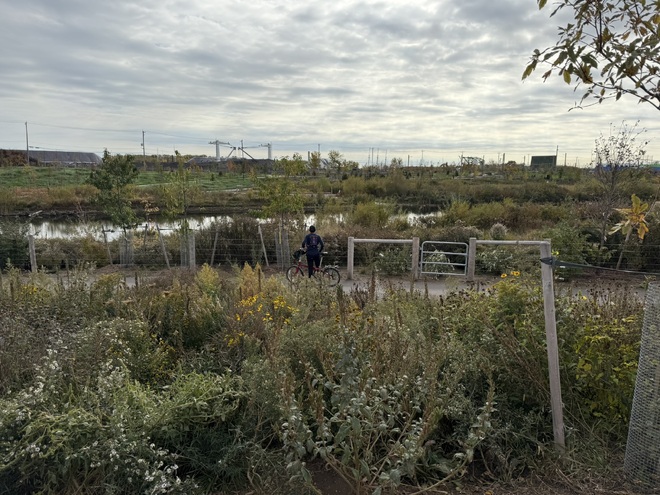
Biidaasige Park recreates a stylised, scaled-down approximation of the marshland and river mouth that existed before that. The masterplan, led by landscape architect Michael Van Valkenburgh Associates, approximates the natural serpentine route lost more than 100 years ago.
Partway through the earthworks, something unexpected happened. With more than 7m depth of dirt and gravel carted away, a construction worker on site noticed some unusual plants sprouting. Works were stopped and botanists discovered hundred-year-old sedges and rushes from the original wetlands springing back to life. And not just that. Soil samples revealed that microbes, larvae, worms, water fleas and zooplankton were wriggling again as though not a day had gone by.
The findings shocked scientists, including University of Toronto associate professor Shelby Riskin. She collected and grew the seeds and plants, returning them to the parkland to be planted. Now, the century-old bulrushes, strange, bushy and thriving, grow in the riverine park, while researchers rush to publish papers on the revival of an ancient landscape and its rehydrated microbiology. The discovery is rewriting the rules about what can be saved and revitalised on post-industrial sites and alternative approaches to soil excavation and remediation.

My kids disappear into the playground – the younger one opts for sand and water play, the older two queue up for ziplines and play on the swings, but there’s less to entice tweens and teens. I’d have liked to see more challenging structures to climb, bouldering or pull-up bars. I meet a local teacher and her kids walking by the river. “I love the sandpits with the water features and dams,” she says. “I wish this park existed when my kids were little. There’s so much learning that could take place that they are too old for now!” Still, her teen is excited to come back with his fishing rod. Fishing the urban rivers is a popular pastime for teens, and you will see them cycling to parks with rods in their backpacks, hoping to catch salmon for sport.
Throughout the park, “step-downs” to the new riverbank offer fishing, birdwatching and slips for non-motorised boats. The park is already a destination for paddleboarders and canoeists. Set to open next year, a future Canoe Cove will offer kayak and canoe rentals and a small cluster of artificial islands to paddle around and explore. A future park, Biidaasige North, planned for 2028, will add an ice skating trail for winter, an event space and a new pedestrian bridge to downtown across the Keating Channel.
The playground is big and located at the park entrance, but it’s small compared with the total size of the riverine parkland, acting as the gateway to nature exploration. Still under construction, a community centre will offer community programmes run by the city, located in a revamped fire station.
The lush plantings of native species are fluffy but not wild. Baker reveals that Waterfront Toronto has spent C$1 million this year on weeding alone to maintain the new landscape and keep out invasive species. But the wildlife moved in without introduction or fanfare, thanks to the creation of diverse habitats, including large dead trees – known as drowned trees – planted upright to provide nesting sites. Turtles, salamanders, beavers, coyotes, foxes, muskrats, minks, frogs and native fish arrived without invitation. “Just this summer I saw a bald eagle fly the length of the river valley, which was amazing to see,” says Baker.


All of the local people I speak to are surprised and delighted by the gift of a new park. They are wowed by the level of care in the realisation of the landscape and the generosity of the spaces.
“I’m mostly just thrilled at how much land was reclaimed for family use – playground, picnics, housing – that was previously wasteland,” says one mother, an immigration lawyer, who cycled to the park with her youngest. “What a win for the city.” She also mentions that it was easy to arrive by bike. “It’s very seamless, compared with other green spaces, which are harder, like the other ravines.”
I speak to another mum who is accompanying her daughter’s Girl Guide troop on a free tour of the park by a City of Toronto employee. (Tours are currently offered free to any group, proving popular with schools and scouts alike.) “I spent years attending seminars and workshops on urban landscaping, forestry, nature, environmental stewardship and accessible play,” she says, as an estate agent who trained as a landscape professional. “I never saw an actual project come together that combined each of these elements together until now. People of all ages can enjoy this park, and I hope schools can adopt and implement these designs too.”
There are questions about what happens next. The masterplan shows dense clusters of tall residential towers bordering the park on vacant land to the north and south. People are unsure how that will feel and whether it will “ruin the park”. But most agree that Toronto needs affordable homes. They are excited to explore “the new park” with their kids – still learning how to say (or resisting learning) its name. The word Biidaasige (bee-daw-sih-geh) translates from the Anishinaabemowin language as “sunlight shining towards us”, and was a gift from an Indigenous-led naming process.
Renaming has been used as a way to erase thousands of years of Indigenous presence in Toronto and across Canada. It was Upper Canada lieutenant-governor John Simcoe who renamed the Don River after its counterpart in England in 1793, replacing a name thought to be Waasayishkodenayosh. Indigenous words are now being given priority in the naming and renaming of Toronto streets, parks and assets to support the revitalisation of Indigenous languages and increase public awareness, according to Toronto’s Reconciliation Action Plan: 2022-2032. Not everyone that I meet is keen on the name– “But it has got us talking about it, and trying to say it,” says one dad. “And that’s a good thing.”
“The new waterfront park represents a big step on the long road to reconciliation”
The Indian Act of 1876 made it illegal to speak an Indigenous language, take part in ceremonies or dances, or gather in groups of more than three – restrictions that weren’t lifted until the 1950s. In addition, the government had the power to remove Indigenous children from their families. Residential schools, where many children were abused or died, operated for 150 years from 1831-1996 with the purpose of destroying Indigenous families, cultures and languages.
Decolonisation in the making of places is new to the city. Settler colonialism is the term for a process of disenfranchisement where waves of immigrants are invited to settle on Indigenous lands. The truth of Canada’s history and legacy has only recently begun being taught in Toronto schools, which used to promote the settler perspective. The publication of the Truth and Reconciliation Report in 2015 was a major catalyst for change. The discovery in 2021 of unmarked graves on the sites of former residential schools led to action plans aligned with the report recommendations.
Indigenous symbolism is incorporated throughout Biidaasige Park, curated through an Indigenous Advisory Circle convened by the City of Toronto. Toronto is the traditional territory of the Wendat, Anishinaabe and Haudenosaunee, and the region has been an important place for Indigenous people for thousands of years. The park is located on the traditional territories and treaty lands of the Mississauga of the Credit. “They have been involved in all aspects of the project,” says Baker. “We work in deep conversation with them as well as other Indigenous communities.”
The process has led to the inclusion of Indigenous plantings such as Sacred Tobacco and White Sagebrush, a ceremonial shade structure designed by Tawaw Architecture Collective, a fire-holder space, five marker trees and Indigenous public art.
“The opening of Biidaasige Park and the new Don River is a profound moment of renewal,” says ogiima kwe chief Claire Sault from the Mississaugas of the Credit First Nation. “Not just for the land and water, but for the relationships that continue to grow here. We are proud to see Indigenous voices, teachings and design woven into this landscape. This project honours the spirit of Biidaasige, ‘the one who brings the light’, and reflects a shared commitment to restoring natural spaces while recognising the deep, living connection Mississaugas of the Credit First Nation has to this territory.”
Toronto City Council chair of the Infrastructure and Environment Committee Paula Fletcher says, “The new waterfront park represents a big step on the long road to reconciliation.”
The incorporation of Indigenous symbolism feels respectful and meaningful, and speaks to the city’s commitment in its action plan to advance Indigenous placekeeping, to build what it describes as “cultural competency and capacity for addressing historical and contemporary injustices against Indigenous communities and work towards repairing the relationship between settler and Indigenous societies.”
Given Indigenous people are more likely to be unhoused in the city, what comes next is just as important: Homes. Waterfront Toronto is aiming for at least 20 per cent of floorspace to be made available for affordable rent. In spite of market turmoil, the project is cracking on.
“We received another billion dollars of investment from the three levels of government in January of this year that has allowed us to move to the next phase,” says Baker. “We’re quite excited about that.”

Timeline of the Park
The last glacial retreat carved a deep ravine and river. The run-off empties into the lake through a large wetland, later called Ashbridges Bay Marsh by settlers. Archaeological evidence indicates the ancestors of Indigenous people likely came to the area around 12,000 years ago, after the retreat of the glaciers
1793
Upper Canada lieutenant-governor John Simcoe named the Don River after a river in England. The town of York was established
1834
The city is incorporated and the original Indigenous name of the place, Toronto, is restored, because it was common on maps and to escape the negative reputation of “Dirty Little York”
1890s
The Don Improvement Project dredges and straightens the river to flush industrial pollutants into the harbour and make space for railway construction, resulting in periodic flooding
1893
City engineer Edward Keating proposes a channel to connect Ashbridges Bay to Toronto Harbour, in another attempt to flush pollution from industrial sources including the brickworks, abattoirs and sawmills.
1912
The Keating Channel is finished and the Don River is forced into a 90-degree turn westward to the Inner Harbour after its natural mouth is filled in. Governments fill in the heavily polluted Ashbridges Bay Marsh to create the port lands, a large industrial district with refineries, coal facilities, factories and shipping infrastructure
1954
Hurricane Hazel stops over Toronto, flooding the city. The Province of Ontario passes the Conservation Authorities Act, establishes the Toronto and Region Conservation Authority and other conservation authorities, and restricts residential development within flood-prone areas
1969
Activists hold a funeral for the Don River to highlight the decay of the river and valley as a result of industrial waste
1989 to 1991
Civic leaders meet to advocate for the restoration of the Don River. The Task Force to Bring Back the Don is formed and releases a 1991 report that envisions a new river mouth in the port lands
2001
Motivated by a bid for the 2008 Summer Olympics, the federal and provincial governments, with the City of Toronto, form the Toronto Waterfront Revitalization Corporation to develop and rehabilitate the city’s waterfront, including the Port Lands Flood Protection (PLFP) project
2007
New York-based landscape architect Michael Van Valkenburgh Associates wins an international competition to design the new port lands
2017
Construction starts on the new river mouth. Plugs prevent river and lake water from entering the construction zone
2024
The city establishes a formal Day One working group to plan for the opening of Biidaasige Park, including the handover from Waterfront Toronto, the park’s designer and builder, to the City of Toronto for ongoing management. The new island created by the new river mouth and the park are gifted the Indigenous names, Ookwemin Minising “place of the black cherry trees” and Biidaasige Park, “sunlight shining towards us”. The “north plug” is removed, allowing the waters of the Don River to flow through the new river mouth, recreating the natural route lost more than 100 years ago
2025
Biidaasige Park opens to the public with future phases including Canoe Cove, expected to open in 2026 and Biidaasige Park North, which adds an ice skating trail and event space, in 2028. A new pedestrian bridge across the Keating Channel will further link the park to downtown, bridging to Waterfront Toronto’s Quayside site

If you love what we do, support us
Ask your organisation to become a member, buy tickets to our events or support us on Patreon
Sign up to our newsletter
Get updates from The Developer straight to your inbox
Thanks to our organisation members
© Festival of Place - Tweak Ltd., 124 City Road, London, EC1V 2NX. Tel: 020 3326 7238