Get updates from The Developer straight to your inbox Yes, please!




Teenage girls feel unwelcome in public spaces but we can help
Avoiding or changing routes remains an all-too-common part of girlhood. BDP senior town planner Antonia May argues that wider consultation and a more diverse built-environment profession can help deliver truly inclusive public spaces


Why are the needs of women and girls not being addressed through the planning and development process? When I began studying town planning 10 years ago, this question was at the forefront of my mind, and the basis of my dissertation. It is still as relevant today as it was then.
The statistics are clear. In 2018, a survey by Plan UK identified that 38% of girls aged 14-to-21 had experienced verbal harassment in public spaces at least once a month. Crimestoppers research from 2023 found that an astounding 77% of girls first encounter unwanted sexual behaviour in public before they reach their mid-teens.
Research published this year by Girlguiding found that over half of girls and young women aged 11-to-21 do not feel safe on public transport, while 48% reported avoiding going out in the dark for safety reasons.
The sad truth is that feeling unwelcome or unsafe in public space remains an all-too-common part of girlhood.
Speaking with female friends and family, it is very rare to find anyone who has not had at least one experience of sexism or misogyny in a public space. Last year, the National Police Chiefs’ Council declared violence against women to be a national emergency.
While fundamental societal challenges play a big role, the built environment sector has a significant part to play
Clearly, there are huge societal influences at play. Parental control is exercised to a greater extent over teenage girls than boys, who are usually allowed to range further from home unsupervised and spend more time outdoors.
The conditioning of girls starts at a young age – in one American study of preschool children, girls had 16% lower odds than boys of being taken outside by their parents to play. An Austrialian study showed that parents encourage young boys to play outside significantly more than girls.
While fundamental societal challenges play a big role, the built environment sector has a significant part to play in shaping inclusive, accessible spaces for girls.
Developers, architects, landscape architects, urban designers, town planners and everyone with a stake in placemaking must strive to meet the needs of teenage girls through design-focused decision-making, policy and consultation. At present, the sector is not doing enough to truly consider the needs and preferences of teenage girls.
There are four key areas to focus on: policy and guidance, public play space design, workforce diversity and community engagement.
In policy and guidance, gender mainstreaming of planning policy – whereby the implications of a submission for all genders are assessed – was first proposed in the late 1990s and early 2000s, but uptake in the UK has been limited. This is now beginning to change with Glasgow and Edinburgh having adopted feminist town planning principles, becoming the UK’s first feminist cities.
More guidance addressing the needs of teenage girls is emerging, and we need to keep building on this momentum with local-planning-authority-specific guidance. Internationally, the UN’s sustainable development goals include gender equality and empowerment of women and girls, exemplified in the Her City project, which provides an accessible toolkit to include women and girls in planning.
More locally, the 2023 Safer Parks guidance has set overarching design principles for parks, including activation, visibility and escape routes, as well as highlighting international best practice.
The London Legacy Development Corporation took this further with its 2024 handbook, Creating Places that Work for Women and Girls. This was developed with input from a diverse cross-section of local women and girls and gender equity experts, and included successful local case studies. While still early days, we must monitor the social value and gender equity outcomes of developments that follow this guidance.
The charity Make Space for Girls has produced guidance documents that establish clear teenage-girl-friendly design features: Social seating instead of standard benches, access to clean and well-maintained toilets, smaller spaces within larger public spaces, a mix of active and passive surveillance and interactive public art.
By engaging young people meaningfully, we encourage a lifelong interest in the built environment and foster a next generation
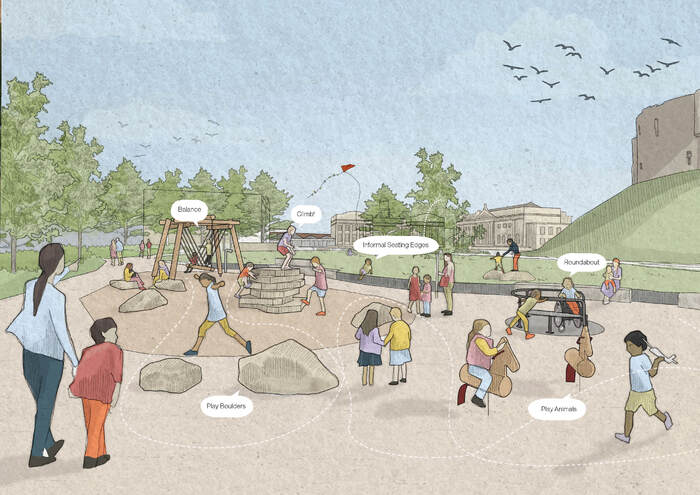
Every site has its own context, but we are beginning to see teenage-girl-friendly design principles incorporated into real projects. At the Eye of York & Castle Gardens project in York, my practice, BDP, included informal, playful opportunities for “hanging out” with clear sightlines across the park and a curved seating edge to encourage socialising—a future haven for girls.
As for representation, the Royal Town Planning Institute (RTPI)’s State of the Profession report from 2023 showed women to be very much the minority in many built-environment roles. Women accounted for only 20% of architects, 15% of chartered surveyors and 40% of chartered town planners. As of 2021, only 7% of Chartered Institute of Building members were women.
In planning, there are signs of hope with gender parity among younger RTPI members. However, nearly two-thirds of the older half are men, and limited data is collected on socioeconomic, ethnic and sexuality backgrounds to provide a true intersectional understanding.
It is no wonder that public spaces often fail to factor in the needs of teenage girls when those shaping the process lack the lived experience to inform sensitive design and are not engaging with excluded groups. Positive steps are being taken but more needs to be done. More inclusive hiring and promotion practices can make a big difference in changing the conversation.
Developers must ask teenage girls what they want and need from new developments, especially during the pre-application stage
Finally, one of the easiest ways to ensure public spaces reflect the needs of teenage girls is to ask them what they want. Engagement should happen as early as possible in the design process, using creative techniques that give girls real influence. At Waterden Green in the Queen Elizabeth Olympic Park, the Greater London Authority proactively involved girls aged 12-to-18 in the design brief and procurement of the design team. This approach both shapes spaces that girls will use, and sends a message that their views and safety are important.
By engaging young people meaningfully, we also encourage a lifelong interest in the built environment and foster a next generation who are invested in shaping the places in which they live.
So, what should the development industry do next to drive meaningful change? First, employ more women in senior roles, ensuring decisions about public space reflect the diversity of the communities they serve. Second, demand well-researched, place-specific guidance for public play space design. Third, take a creative approach to placemaking, moving beyond the conventional to deliver genuine social value. Finally, developers must ask teenage girls what they want and need from new developments, especially during the pre-application stage, so public spaces are both accessible and welcoming.
Many women can identify with having avoided an alleyway with poor visibility, decided against an evening run, or changed routes to avoid being followed, stared at or spoken to by strangers.
If we can take steps to improve representation, engagement and policy, while remaining aware of wider societal issues, we can make a critical, positive contribution to the experiences of teenage girls, creating public spaces where they feel safe and included.
Antonia May is a Senior Town Planner at BDP
If you love what we do, support us
Ask your organisation to become a member, buy tickets to our events or support us on Patreon
Sign up to our newsletter
Get updates from The Developer straight to your inbox
Thanks to our organisation members
© Festival of Place - Tweak Ltd., 124 City Road, London, EC1V 2NX. Tel: 020 3326 7238