Get updates from The Developer straight to your inbox Yes, please!




Designing for adolescents: Teen inclusion demands a redistribution of power
The city for adolescents is a landscape of restrictions. We must give them influence and agency, writes Benazir Noor Mohamed


Adolescents are both everywhere and nowhere in the city. They occupy a liminal social position, seen as too old for playgrounds yet not fully integrated into adult society, leaving them with nowhere to go.
Public space, which should be their stage for social connection and exploration, becomes a landscape of restrictions. Loitering laws, curfews, skateboarding bans, these are the urban codes of adolescence. As one urban practitioner said, “We design for childhood, we design for adults, but adolescence simply falls through the cracks.”
Girls feel it most acutely. In the UK, only a third of teenage girls take part in park sports, while 73% say they feel watched in public spaces. The message is clear: The city is not theirs.
This absence isn’t accidental. It’s a by-product of systems, policy, planning, governance, that have for decades treated adolescents as passive recipients rather than active contributors to the built environment. Exclusionary practices, from hostile architecture to adult surveillance, create an experiential deficit shaped by control and oversight.
Without systemic shifts, engagement risks remaining procedural rather than transformative
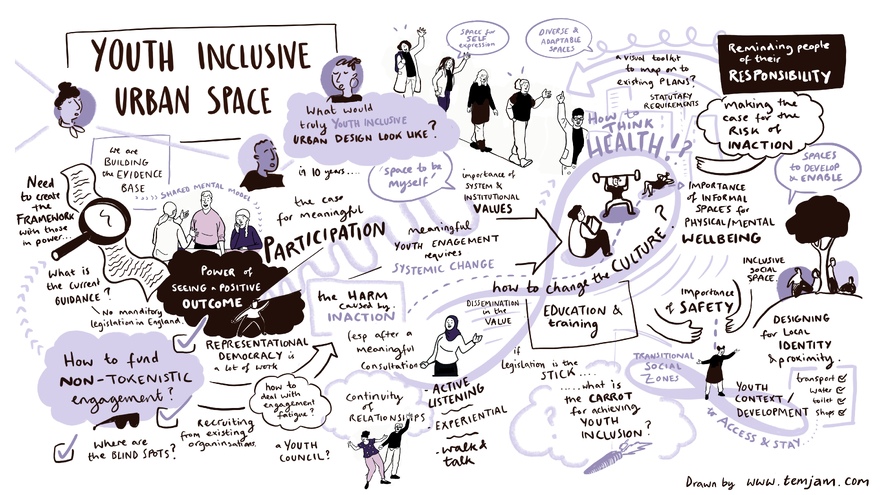
The solution isn’t another youth consultation or colorful mural project that ends when the funding cycle does. During my research for my dissertation at University College London, the designers and policymakers that I spoke to described how participation often stops short of real influence – a tick box exercise. Adolescents don’t need to be asked what colour the benches should be; they need to be trusted as co-authors of urban life.
True inclusion demands a redistribution of power, ensuring that adolescents hold a substantive role in urban governance, embedded in design processes, policy formation, and long-term decision-making. This requires systemic support such as sustained funding, responsive governance cultures, transparent decision-making processes, participatory methodologies grounded in local realities and targeted capacity building for both young people and adult stakeholders. Without these systemic shifts, engagement risks remaining procedural rather than transformative.

When adolescents are seen as legitimate stakeholders, the transformation is remarkable. Their insights challenge complacent assumptions, reveal blind spots, and restore humanity to the sterile logic of urban systems. Yet, as one workshop participant said “What’s the carrot to make people want to do it”.
Institutional leverages such as policy or funding leverage for adolescent inclusive development could inspire stakeholders and reduce neoliberal planning bias which, when combined with evidence-based best practices, would lead to more meaningful adolescent engagement.
Cross-sector collaboration and consistent national guidance are vital to reinforce these systemic changes, ultimately promoting holistic adolescent wellbeing and elevating the societal value placed on young people. This integrated approach highlights the interconnected levers needed to transform planning systems towards greater inclusivity and sustainability.
For my dissertation, I developed a framework for what I call adolescent-inclusive urbanism, a systems-based approach that links wellbeing, participation, and governance. While not a linear metrics-based tool, it provides a practical, evidence informed understanding for strategic decision making in creating adolescent inclusive urban spaces.
The framework acts as a holistic guide rather than a rigid step-by-step tool, helping stakeholders create adolescent-inclusive spaces through four core stages:
1 Understand – Establish a contextualised understanding of adolescents’ lived experiences, shaped by developmental, spatial, social, and cultural factor
2 Engage and Empower – Build the capacities of adolescents and professionals alike, promoting participatory literacy, shared authorship, and meaningful adolescent agency in urban processes.
3 Co-Design and Implement – Integrate adolescents as co-decision-makers through structured collaborative models, ensuring their perspectives shape planning, design, and evaluation.
4 Institutionalise and Sustain – Embed adolescent engagement within long-term governance structures by integrating it into policy frameworks, funding mechanisms, accountability systems, and cross-sector collaborations.
This ensures that adolescent inclusion becomes a sustained institutional practice rather than a discretionary or episodic initiative. These steps form a living, interconnected system. When participation is meaningful, it fosters trust, visibility, and wellbeing. When it’s tokenistic, the system collapses into fatigue and cynicism.
Urban space is never neutral. Every bench, every plaza, every line of policy communicates who is welcome and who is not. By designing exclusion into the everyday, we have told an entire generation that they do not belong in their own cities.
But when adolescents are invited in, when they are asked not what they want, but what they see, the city changes. It becomes layered, playful, curious again. It begins to breathe.
As one stakeholder put it during the interview, “We need to stop seeing youth engagement as a favour, it’s an investment in the city’s future.” Cities that grow with their young people are cities that endure. They are safer, more inclusive and infinitely more alive.
The challenge is not about adding youth spaces to the map; it’s about rewriting the map itself, shifting from control to collaboration, from consultation to co-creation, from tokenism to transformation.
Ultimately, adolescent-inclusive urban spaces should be designed not merely for access but for stewardship, creating opportunities for adolescents to actively participate in urban governance, co-manage spaces, and foster long-term care and engagement with their environments.
Our cities have long demanded that adolescents adapt to them. It’s time they began to adapt to adolescence
Benazir Noor Mohamed is an architect with 10 years of professional experience and a recent Master’s degree from The Bartlett, UCL. She serves as an Advisory Board Member at the International WELL Building Institute (IWBI), is a strong advocate for healthy and sustainable buildings, and is currently a Research Associate at University College London.
Sign up to our newsletter
Get updates from The Developer straight to your inbox
Thanks to our organisation members
© Festival of Place - Tweak Ltd., 124 City Road, London, EC1V 2NX. Tel: 020 3326 7238