Get updates from The Developer straight to your inbox Yes, please!





Built Barriers: “Women’s needs are disfavoured, deprioritised, even endangered by our built environment”
Part W Collective shares what they’ve learned from collecting images of barriers to inclusion in the built environment and what comes next in the campaign – including a free Festival of Place event on 3 December


Let us tell you a story about built barriers. It takes place in London – Hackney Downs. Along one side of the park, there’s a railway embankment, and cut through under the line are a couple of tunnels. They have unreliable lighting, an ever-changing gallery of graffiti and the faint smell of urine. At one end of these tunnels is the park, well-loved and used in every season. At the other end, one tunnel cuts down a long alley to a main road; the favoured of the two leads into a small industrial estate reborn as artist studios, places for coffee, yoga and pop-ups.
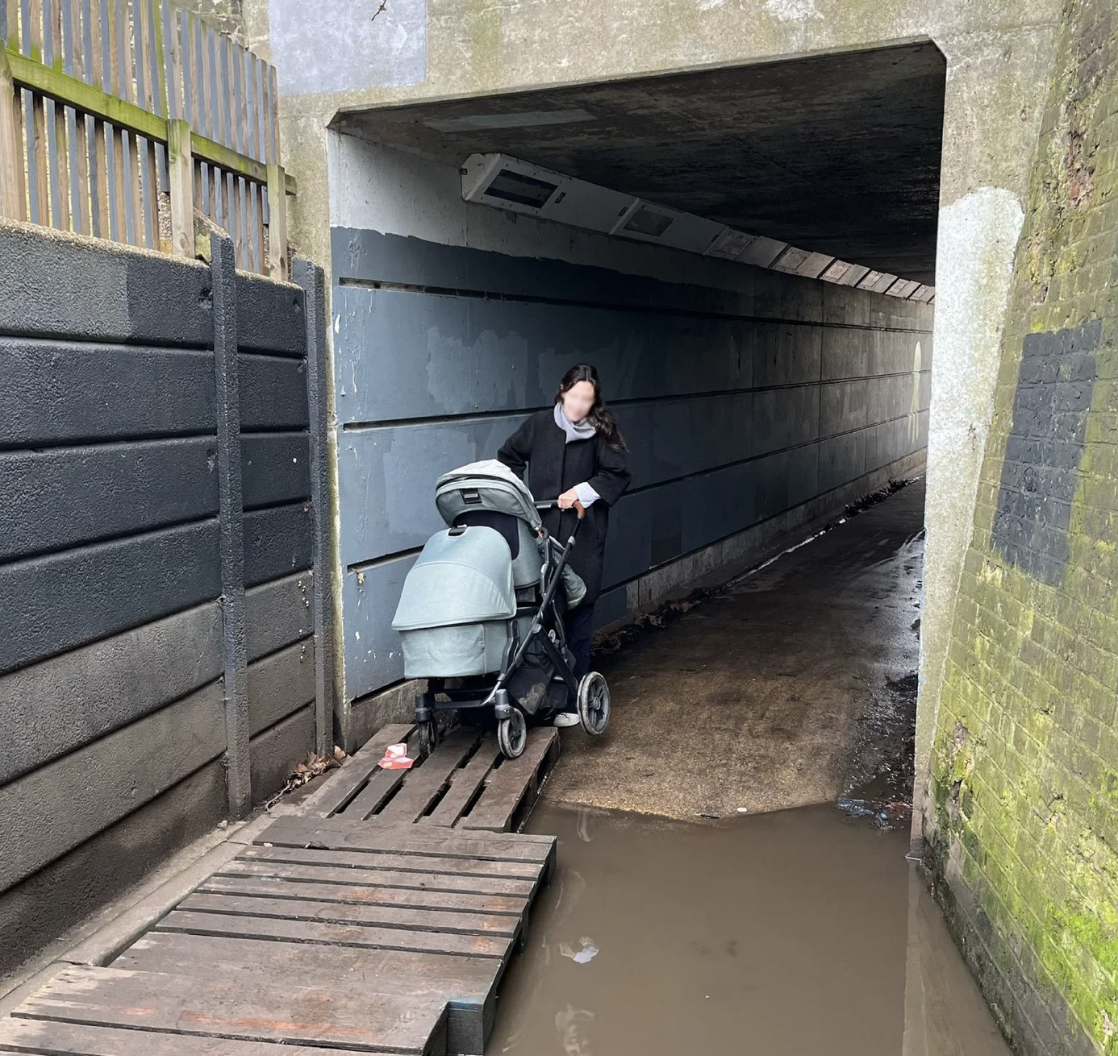
Nothing exceptional you might say. Except that after heavy rain, the better-used of the two tunnels develops a rather large puddle. It swamps one end of the passageway to about ankle height, meaning it’s impassable to anyone who doesn’t want to get their feet wet.
The spirit of community in Hackney is such that someone brought down a stack of wooden pallets, and these are deployed whenever there’s heavy rain to create a rickety bridge across the flood. But imagine trying to cross those stepping stones with a pram, with toddlers in tow or in a wheelchair, with impaired vision, or if you were unsteady on your feet.
The puddle has become an in-joke and social media meme, even appearing in the national press. How have we come to the point where we’ve not just normalised this built barrier, but turned it into a minor local celebrity?
In Part W’s first year of crowd-sourced submissions to our Built Barriers campaign, we’ve uncovered many examples of places that, like the Hackney puddle, show how women’s needs are disfavoured, deprioritised, even endangered by our built environment.
These include places where women feel vulnerable or unsafe, such as badly lit alleyways and tunnels, desolate bridges and underground platforms; places where unexpected bus stop closures extend the late-night walk home. The solution is often to find another route – placing women on diversion – adding time and energy to their disproportionate burdens of depressed wages and caring responsibilities.
For parents, there are places impassable to buggies, whether that’s due to inconsiderate parking, unmanaged vegetation or thoughtlessly planned building works. There are bathrooms without space for baby changing, with sinks too high for children to wash their hands independently. And there’s bathroom poverty – long queues of women waiting for insufficient toilets while extra urinals are provided on the street for men.
It’s striking how many of the built barriers shared with us relate to natural features – overhanging hedges, erupting tree roots, ice and snow, puddles – or relate to different behaviour patterns during the day and night.
Many of our participants talked about the ways that societal misogyny plays out, from catcalling to caregiving, devaluing and deprioritising women’s lived experience and persistently reinforcing inequality.
There is also a feeling that to bring heft to the issues, there need to be more women in leadership and decision-making roles – and we need male allies to join our struggle – with the agency necessary to break down structures of power and influence.
Education is also critical if we’re to ensure that the next generation understands the issues around built barriers. We need to build awareness of the ‘other’ – barriers can affect different ages, abilities and identities in many different ways – and put gender firmly on the radar. To build awareness, we need to make sure that all those studying to work in the built environment learn about built barriers. We need to put it on the school curriculum.
Participants in our research are frustrated by the current policy landscape, which is structured by outdated priorities. And once a barrier is in place it’s hard to change. Cost is usually a priority, which then becomes a barrier.

Some of the issues highlighted in the submissions may seem to many like relatively minor maintenance or management issues – a curb here, a puddle there – but we have found that these examples point to systemic choices that reveal equitable access to the built environment is not a priority.
The examples we’ve collected are helping us understand the scale and nature of the issues we face, but our work won’t stop with collecting lived experiences and data. We want to take action. In the next phase, we’ll be searching out why built barriers happen in the first place.
Join the conversation as Part W joins forces with Festival of Place for a free event: Built Barriers, online from 1-3pm on 3rd December 2025. Hear rapid-fire talks from 8 speakers with breakout discussions to follow. Free – sign up now
Sign up to our newsletter
Get updates from The Developer straight to your inbox
Thanks to our organisation members
© Festival of Place - Tweak Ltd., 124 City Road, London, EC1V 2NX. Tel: 020 3326 7238