Get updates from The Developer straight to your inbox Yes, please!





“At Trinity Buoy Wharf, our buildings were built from the very means that killed the port – the shipping container”
To kick off this new series of book reports, John Burton shares how reading The Box revealed the profound impact of technological change on economies and places and the importance of standardisation and open-source thinking


Last year I suggested to The Developer’s editor-in-chief Christine Murray that it would be good to have built environment book reviews in The Developer. Over the course of our correspondence, this evolved into people from the sector recommending books that have inspired them and influenced their work. She asked me to kick it off, and so here we go.
My first task was to identify the book – no easy feat. I managed to narrow it down to The Power Broker: Robert Moses and the Fall of New York by Robert A. Caro (1974) – a massive tome at almost 1,200 pages, but a brilliant analysis of the corrupting influence of power and Moses’ impact on the urban landscape of not only New York, but right across the world. Next, William Whyte’s City: Rediscovering the Center (1988) which was one of the first books I read on how urban spaces were used – it blew my mind. Finally, Happy City: Transforming Our Lives Through Urban Design (2013) by Charles Montgomery about how city design directly impacts human happiness, psychology and behaviour.
But when I went to find these books on my bookshelf, I saw The Box: How the Shipping Container made the World Smaller and the World Economy Bigger by Marc Levinson (2006). An in-depth study of the shipping container, I got it a couple of years after it was first published. At the time, I was working at Urban Space Management in East London, helping develop and manage Trinity Buoy Wharf (TBW), a former industrial site on the Thames.
On tours around TBW, I used to point out that our buildings were built from the very means that killed the port. We started using shipping containers to create workspaces back in 1999. Now there is a total of five large container buildings at TBW, each with unique design elements, mainly serving as workspaces with some live-work uses, including a building of reconfigured containers used by Thames Clippers, the largest employer on the Thames, with over 500 staff.
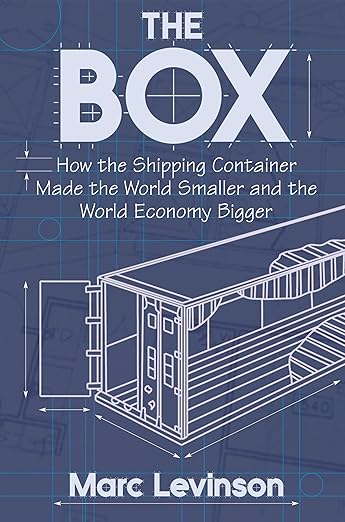
The Box gives a well-researched and fascinating history of the shipping container. Since the early 1900s containers had been used for holding goods on ships, but not in any standardised size. As with other types of cargo, these containers were loaded into the holds of ships by scores of dock workers (stevedores).
It was the dream of Malcolm McLean, an American trucker with no maritime experience, to transform the way that goods were transported by ship that led to the container system we see today. He campaigned from the early ‘50s to bring standard containers into widespread use.
Large containers were first trialled in the USA in 1956 using ship-based cranes, with land-based cranes introduced between 1957 and 1959, making the process more efficient. The first international journey occurred in 1966, and the first purpose-designed container ships began crossing the Atlantic from the USA to Europe in 1968. A 1955 trial showed standard ship loading cost $5.83 per ton, but containers reduced it to $0.158 per ton – containers were almost forty times cheaper.
The idea to use shipping containers as buildings was not led by design but economics
By 1971, most ships on the Trans-Atlantic route were container vessels, signalling a complete transformation in just three years. This shift had a massive worldwide impact, and very notably led to the decline of ports all around the world.
It took about 5 years to kill the Port of London. Dock worker numbers dropped from 120,000 in the mid-1960s to just 6,000 by 1971. East India Dock (near TBW) closed suddenly in 1967 and the Royal Docks were the last to close in 1981 – the year that the government launched the London Docklands Development Corporation to regenerate 5,120 acres of mostly derelict land in Newham, Tower Hamlets and Southwark. Today Canary Wharf covers 128 acres with over 16.5 million square feet of office and retail space and capacity for around 125,000 workers.
Using shipping containers to create workspaces at TBW was an inspired idea by Eric Reynolds, USM’s Managing Director. Whilst he didn’t invent the idea of using shipping containers as buildings, his contribution to the art was in joining them together to create larger workspaces and stacking containers to make buildings with several floors.
The idea was not led by design but economics: To create buildings as cheaply as possible to keep the rent lower for tenant end users.
At that time, in that part of East London, grants were not available. A private loan would not cover the build cost as the rental return in the area was too low when capitalised – that means the rental income would not cover the loan repayments. Instead, the project was self-funded.
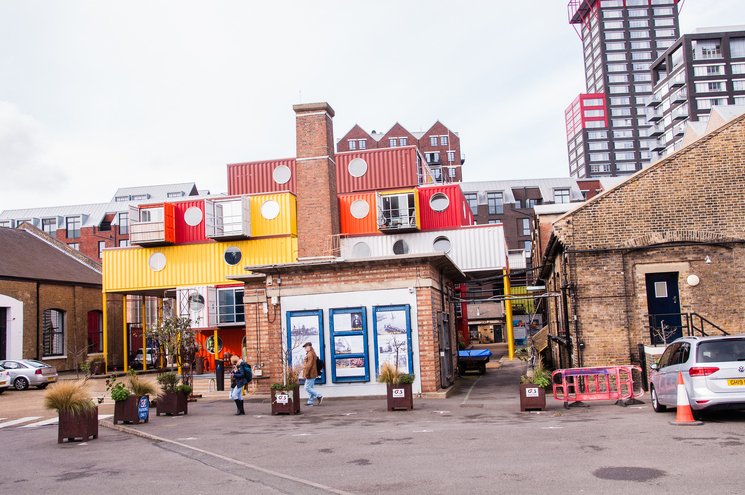
In the late 90s there was a glut of imported containers in the UK – with more imports coming in than goods flowing out (probably still the case), which meant that second-hand containers were really cheap to purchase. All these factors combined to create a moment of opportunity which proved be transformative for TBW.
Building with shipping containers aligned with Reynold’s philosophy of “lighter, quicker, cheaper”. The reuse of materials, saving their embodied carbon, is another important benefit.
Over the years, we designed and constructed 4 main buildings using this container method plus a set of classrooms, music studios and gallery spaces, all to a high spec and compliant with building regulations. We soon realised that the use of this form of building was not just limited to our site, and that it could be used anywhere. To realise this, Container City Ltd was set up and went on to do many more commercial container building projects around the UK.
The provision of housing was always an aspiration for containers but so far not realised for a host of complex reasons, mainly related to issues around NHBC insurances and container homes being frowned upon by mortgage lenders. Others have done it with mixed results, but container homes have been mostly self-build driven.
As for The Box, the book explains how containerisation coincided with the decline of the British Empire and the rise of alternative ports, allowing former colonies to export cheap goods to all markets, not just to the UK. The success of new container ports depended on having deep water. Countries that invested early in container facilities thrived and remained competitive.
Tilbury became London’s nearest port for containers. It was modified in 1967 to handle deep-water ships and provide associated dockside parking, a job not easily done in the Port of London. Resolving labour relations in Tilbury took three years with the port opening in 1970.
Globally, containerisation led to a sharp drop in pilfering, but also severe unemployment and social issues in affected areas. “Dockland” (1986 NE London Polytechnic and GLC) notes several major dock strikes related to containerisation, with the last in London in 1972 involving around 170,000 workers. It notes that while worker action had previously improved employment conditions, “in opposing modernisation it is likely that the dockers’ militancy was a factor in the decline and eventual death of London’s docks”.
A major breakthrough for containers was the agreement of International Standards (ISO) for their sizes in 1964, and standardised pick-up points in 1967 using the McLean node design. McLean allowed free use of his design, aiding worldwide adoption of the system.
During the Vietnam War from March 1967, containers proved essential for efficient supply chains from originating factories to the front line, with 20-foot containers proving the most popular. Sea Land, McLean’s company, included towing vehicles and port upgrades in its successful Vietnam supply bid. Today, container ship capacity is still measured in TEUs (twenty-foot equivalent units).
The book highlights how containers revolutionised global shipping and ship design, enabling East Asian countries with cheap labour to access new and historic markets affordably. This negatively affected domestic industries in high income nations and shifted the importance of the North Atlantic transport routes to Asia-Europe routes.
"Just in time" manufacturing became viable thanks to containers and computerisation, reducing the need for warehouses but increasing demand for dockside parking space. Faster loading and unloading worked well with digital inventories. But containers made inspection more difficult, leading to increased people smuggling and trafficking of illicit goods.
Initially, standard freight ships were refitted to carry containers, but from 1968-9, purpose designed second-generation container ships were used. Capacity and size have grown, with the largest ships now over 400m long and able to carry over 24,000 containers stacked 26 high. They mainly work the Asia-Europe routes due to deeper waters than most American ports.
A key lesson is to work within the constraints of the container. Don’t add on too many extras
Container buildings are in the book as an unintended consequence of the shipping revolution. There is a future for the type: Container buildings sit within the overall modular building movement which is an important contributor to the built environment today, and one that will grow over time. But containers are not the answer to everything.
A key lesson is to work within the constraints of the container. Don’t add on too many extra design elements that add cost, thus negating the benefits of working with containers.
In 1999 at TBW, the cost to build a new workspace building was £1,290/sqm. The bank would lend £377/sqm leaving a deficit of £915/sqm. So we set out – and managed – to build Container City 1 at £377/sqm. It was cheap and very cheerful.
Costs increased a lot over the years, driven particularly by updated building regulations and inflation during the Covid years. In 2025, one of the architects used by Container City compared a range of modular building types with the traditional build cost for a temple. At £2,351/sqm, the Container City scheme was still about 30% cheaper than a traditional build (£3,410/sqm) and about 9% less than the cheapest modular building type. The container building also included all fees and ground works which the others did not.
For other building types, such as workspace, the cost saving could be around 25%. So containers are still a cheaper option than taking the traditional approach. One of the reasons for this differential is that most modular building companies have to keep a factory running with reasonable throughput of goods to cover overheads. Container City uses a third-party fabricator that is not fully reliant on container conversion work.
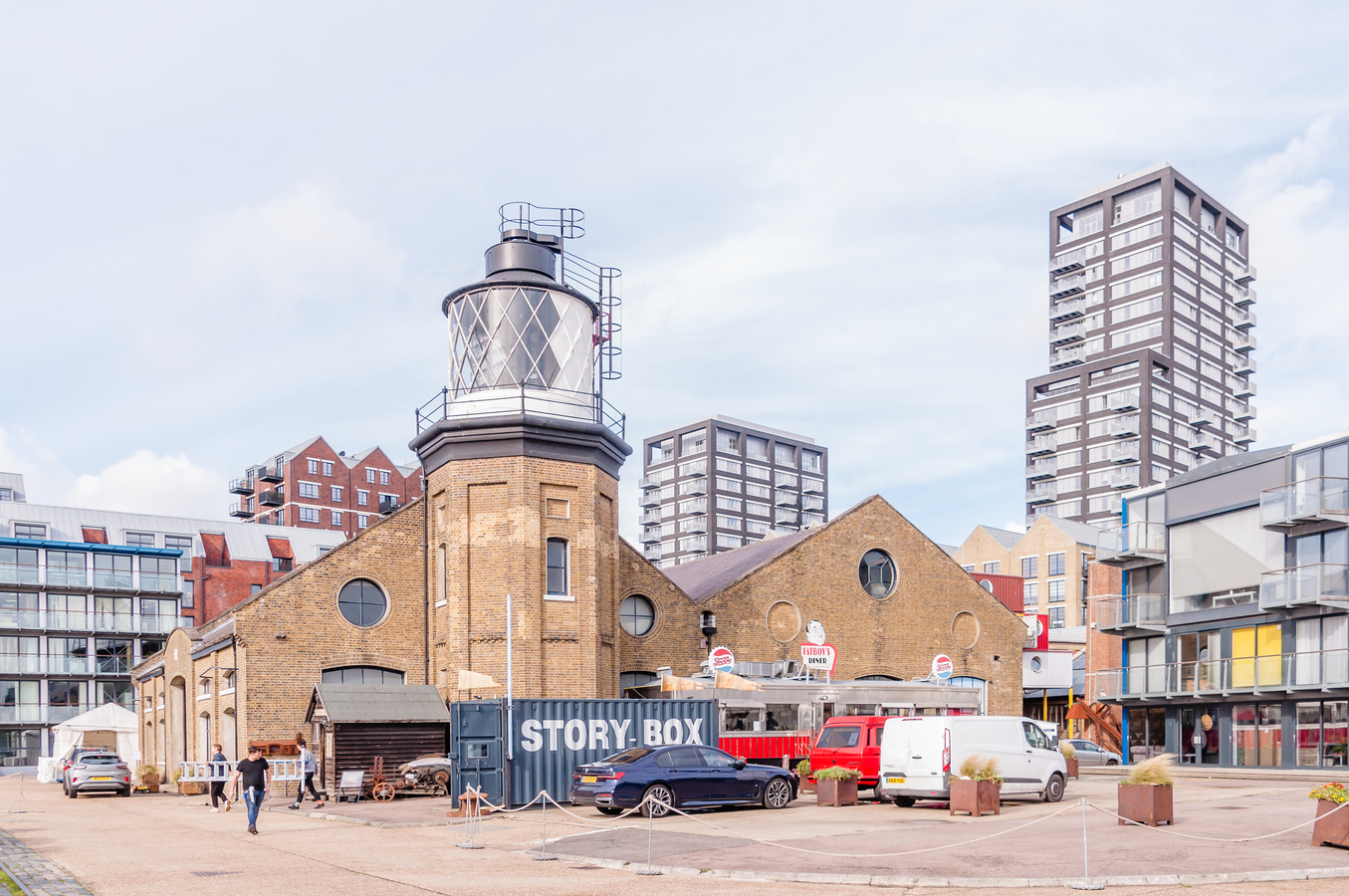
Protected from redevelopment into dockside housing through a lease covenant, TBW has become a fascinating mixed-use site, home to many creatives, artists and an art school plus London’s only Lighthouse – home to “Longplayer”, a sound installation to mark the new century and due to run for 1,000 years.
It may not be a book on urban design or cities but The Box did expand my understanding of the profound and unintended consequences of technological change on economies and places. It also highlights the importance of ISO standardisation and open-source thinking.
It was a struggle to get the conservative maritime business culture to accept shipping containers, but once up and running, the change was so fast. Repurposing containers for buildings at TBW was in direct response to the technology that had swept the world not many years before – a journey so well explained by this book.
Sign up to our newsletter
Get updates from The Developer straight to your inbox
Thanks to our organisation members
© Festival of Place - Tweak Ltd., 124 City Road, London, EC1V 2NX. Tel: 020 3326 7238