Get updates from The Developer straight to your inbox Yes, please!




Future Homes Standard: “This must be the start of the journey, not the end”
Industry welcomes announcement of the Future Homes Standard, but pushes government to be more ambitious


The government published details on the Future Homes Standard (FHS) this week, a move welcomed by industry for bringing much-needed clarity to its timeline and contents more than a decade after the standard was first announced.
But the FHS, which was expected to be in force by next year, will not be enacted until 2028, drawing criticism for its unnecessary delay – and the standard’s lack of ambition.
Christopher Hammond, chief executive of UK100, a network of local councils, says, "Let’s be honest: 2028 is later than it should be. Every year of delay is another year of homes built to standards we’ll regret."
The UK Green Building Council also underlined the urgency of progressive action beyond the announced standard, saying, “This must be the start of the journey, not the end.”
“Many developers are already building to higher standards,” the UKGBC adds, “and are eager to help ensure the next update delivers genuinely future-ready homes by the early 2030s – comfortable, affordable to run, climate-resilient and zero-carbon.”
“We’re pleased the Future Homes Standard is finally here,” says Mellis Haward, director of Archio Architects, adding the FHS is “giving the sector the clarity we’ve needed to invest confidently in low-carbon technologies and supply chains.”
“The 75% carbon reduction target, compared to 2013 Buildling Regulations standards, is a genuine step forward,” Haward adds. “We’ll see heat pumps, solar PV and much tighter fabric standards as the new normal from March 2027, delivering warmer, cheaper-to-run homes that genuinely support better living for residents.”
That said, Haward says the industry’s disappointment is fair: “For us, true leadership would mean even stricter airtightness standards, mandatory post-occupancy testing and stronger incentives to exceed these baselines from the start.” Archio is already working with the Crown Estate and TOWN on Westwick Row, a development where all new homes will be designed to Passivhaus standard, net-zero carbon in operation, with solar panels and air-source heat pumps.
Andy Macintosh, senior associate at architects Feilden Clegg Bradley Studios agrees, “For us, this new standard is not really a step up.” While Macintosh welcomes the arrival of the FHS, he says the practice is already accustomed to working to more stringent targets: “At FCBStudios, we already have many schemes working to Passivhaus standards or meeting planning requirements set by progressive authorities such as Bath & North East Somerset Council.”
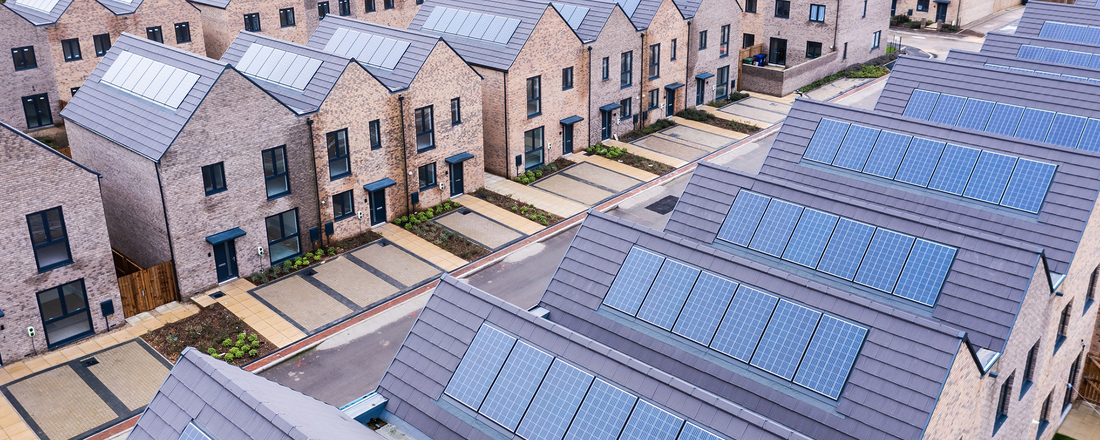
The FHS will make solar panels a “default” feature on some new-build homes by 2027 and mandates that PV panels should cover at least 40% of the roof area. The standard will also increase energy efficiency and ventilation standards.
But the standard has failed to tackle wood-burning stoves, with their installation permitted in new homes. There are also loopholes for some buildings such as those above 18 metres, which have been given more time to adjust to the new standard and have been excluded from the requirement for solar panels.
Amanda Williams, head of environmental sustainability at the Chartered Institute of Building says the FHS represents a "step change" but is not as strong as it could be: “The requirements could be stronger still by covering embodied carbon for example... We also think there should be a requirement for ongoing monitoring of energy efficiency once a new home has been sold and occupied.”
Haward also points to the performance gap, “While it future-proofs new build against fossil fuels, it doesn’t go far enough to close the performance gap we’ve seen for years between design promises and real-world outcomes, particularly in affordable housing where budgets are tight and quality control is everything.”
The National Housing Federation welcomed the inclusion of heat pumps and solar in the standard, saying: "The role of low‑carbon technologies within the Standard – including heat pumps, supported by digital instruction manuals for residents, as we recommended to government. We also support the important role for solar panels, and the sensible recognition that it will not be appropriate in every circumstance, and the provision for new homes to connect to heat networks in a compliant way."
Matthew Scott, policy manager at Chartered Institute of Housing, says the FHS is "the final piece of the jigsaw that will give housing professionals the certainty they need to expand their housebuilding programmes. We welcome the government’s decision that all new homes will be built with low-carbon technology and higher levels of fabric performance, which will futureproof current and future generations from fuel poverty."
The government also published updated versions of Approved Document F (Ventilation) and Approved Document L (Energy and greenhouse gas emissions).
If you love what we do, support us
Ask your organisation to become a member, buy tickets to our events or support us on Patreon
Sign up to our newsletter
Get updates from The Developer straight to your inbox
Thanks to our organisation members
© Festival of Place - Tweak Ltd., 124 City Road, London, EC1V 2NX. Tel: 020 3326 7238