Get updates from The Developer straight to your inbox Yes, please!




Zodiac, London Borough of Croydon for Common Projects with shedkm, Planit, Whitby Wood, Skelly & Couch, Gardiner & Theobald and Awesome Construction
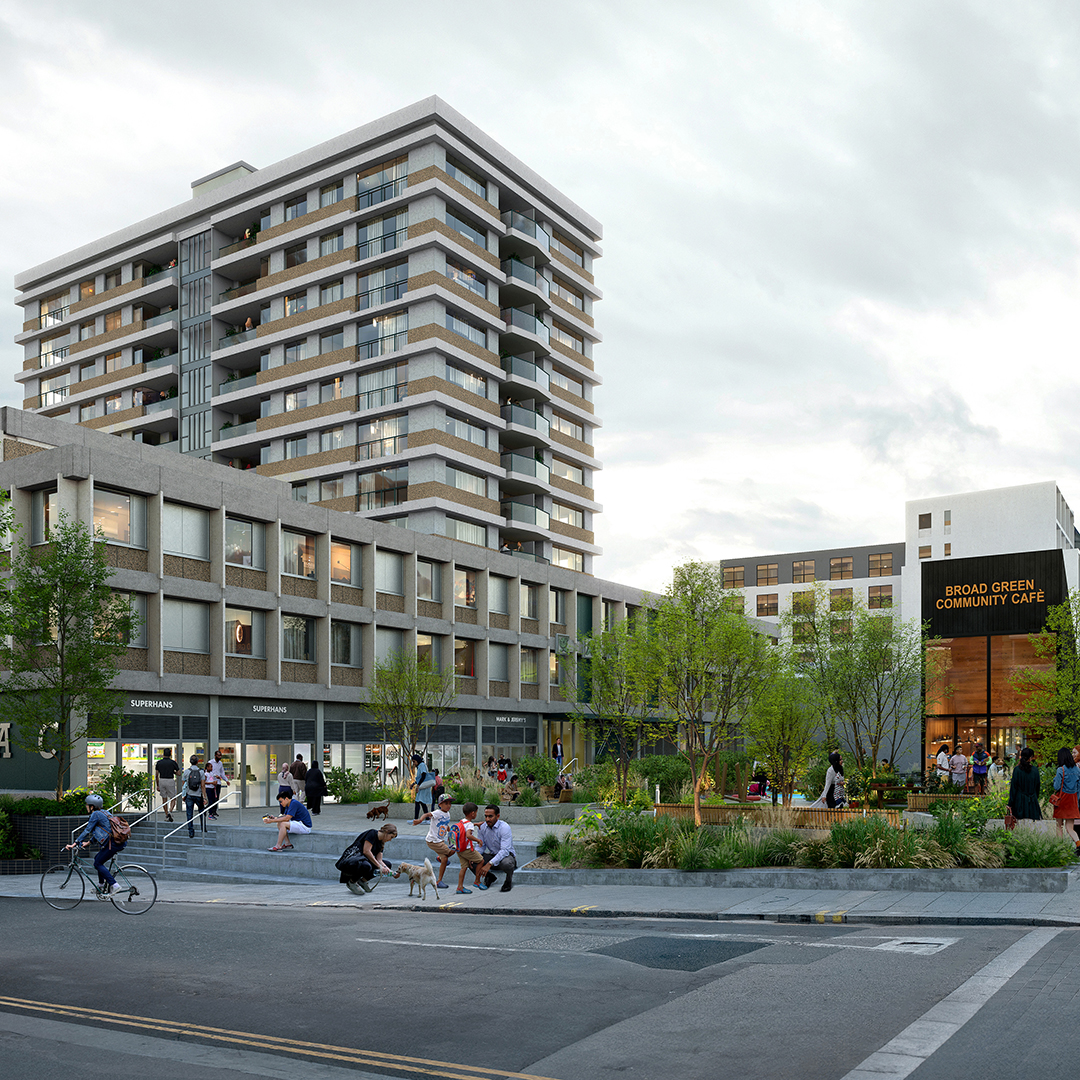
Zodiac, London Borough of Croydon for Common Projects with shedkm, Planit, Whitby Wood, Skelly & Couch, Gardiner & Theobald and Awesome Construction
Zodiac sees the transformation of a worn-out, concrete 1960s complex in West Croydon into 73 high quality homes for families at risk of homelessness, with new community facilities and a new public square. It demonstrates a commercially viable and sustainable retrofit model that serves both new and existing residents, local community groups, and the Council, all within the framework of the site’s unique architectural context. Zodiac has provided an ingenious solution to urgent housing needs in the area, while improving public realm and communal facilities.
Describe the context of this project, its neighbourhood and people.
Zodiac House was built during the 1960s era of optimism and redevelopment in Croydon. Initially occupied as an office, a shifting urban landscape saw the modernist building fall into disrepair, eventually left vacant for 30 years. No longer occupied, it became an eyesore in the neighbourhood, attracting anti-social behaviour and creating a spatial void on the high street. Like many London boroughs, Croydon Council has been facing a housing emergency. 132,410 households in England now live in temporary accommodation, and local authorities are spending £5.5 million per day in London alone procuring mostly private-sector emergency accommodation. One of the worst affected boroughs, Croydon Council has taken a 999-year lease on the flats, giving it a resilient solution and a replicable model for future developments. The retrofit transforms the outdated concrete building into 73 energy-efficient, high-quality homes, acquired by Croydon council as temporary accommodation for local families at risk of homelessness. One of just 20 exemplar schemes selected for The Architects’ Journal’s Good Homes For All campaign, Zodiac maximises natural light, offers generous layouts, and provides welcoming communal areas. A neglected undercroft is reimagined as a bright residents’ lounge, overlooking landscaped courtyards. The previously fenced-off tarmacked forecourt is reimagined as a public garden, with new landscaping and public realm enhancements to benefit residents and the surrounding community. Continuing their commitment to reuse, shedkm repurposed a cross-laminated timber pavilion - a former marketing suite - as a community space and café run by Communities First Foundation & Croydon Business Alliance.
Describe the intervention you’ve made including its purpose and motivation. Please explain the governance of the project, describing its viability and any consultation and community engagement undertaken.
Zodiac sees the transformation of a deteriorating 1960s office building into urgently needed temporary accommodation for families at risk of homelessness. The building was a blight on the high street - attracting crime, wasting space, and damaging the community’s pride of place. The intervention provides 73 urgently needed homes, while creating new public space and amenity. Homes England provided development finance for the project, recognising its significant impact potential, and purpose-led developer Common Projects worked with shedkm to unlock the economic and social value of the site. Planning was granted in 2021, and the project started on site in 2023. Croydon Council acquired the homes in 2025, which have since been occupied as temporary emergency housing.
The project involved significant stakeholder engagement with the council and community, with particular consideration given to traditionally marginalised groups. A total of 810 members of the community were engaged: 457 people in one-on-one conversations and 353 people across 136 focus groups. Responses were overwhelmingly positive, with 94% saying that they felt the proposals were either very good (34%) or good (60%). 6% were neutral and no one thought the proposals were poor or very poor.
South East Designing Out Crime were engaged for three consultation sessions, influencing the scheme’s safety. The Twentieth Century Society also gave their support, calling Zodiac an important building to retain and reuse. We also supported the outreach and engagement activities of local lottery-funded Big Local Broad Green, resulting in the delivery of the community centre.
How does this project make use of an existing structure, place or building in a creative way? Is it innovative? How will this project continue to evolve or enable future flexibility and adaptation? Have you considered its resilience?
The retrofit both retains the concrete structure and celebrates its visual identity by reusing existing concrete precast panels, concrete fins, and characterful façade details. Structural engineers Whitby Wood used detailed investigation and analysis to minimise interventions and keep the original building fabric intact, adapting the building as efficiently as possible.
Zodiac uses an innovative permitted development route to convert underused commercial space into a high quality scheme. Rather than maximising unit numbers (a prior submission proposed 115 homes), the project delivers 73 well-proportioned, adaptable homes. Specified to social-rent and private standards, the flats function as temporary accommodation while remaining readily convertible, offering councils a viable model for repurposing existing buildings while raising social housing standards. Meanwhile, the pavilion demonstrates innovative circular timber construction: the CLT structure was deconstructed, transported, and reconstructed in West Croydon to provide a welcoming community space, proving the viability of repurposing materials.
Internal layouts use light touch interventions to allow modification without major works. All flats meet standards that support future conversion if temporary accommodation is no longer required. The repurposed pavilion further enables flexibility as needs evolve.
Retaining the cultural heritage of the building preserves its position in local memory, while opening up the forecourt and providing the garden and pavilion as community amenity helps create moments of public interaction. Feedback from South East Designing Out Crime has been integrated to ensure the space is safe for current and future populations.
Sign up to our newsletter
Get updates from The Developer straight to your inbox
Thanks to our organisation members
© Festival of Place - Tweak Ltd., 124 City Road, London, EC1V 2NX. Tel: 020 3326 7238