Get updates from The Developer straight to your inbox Yes, please!




Trollhättan 6, Malmö, Sweden for Skanska Fastigheter, Riksbyggen and Malmö Stad with Kjellander Sjöberg, Förstberg Ling, We Made That, Ramboll
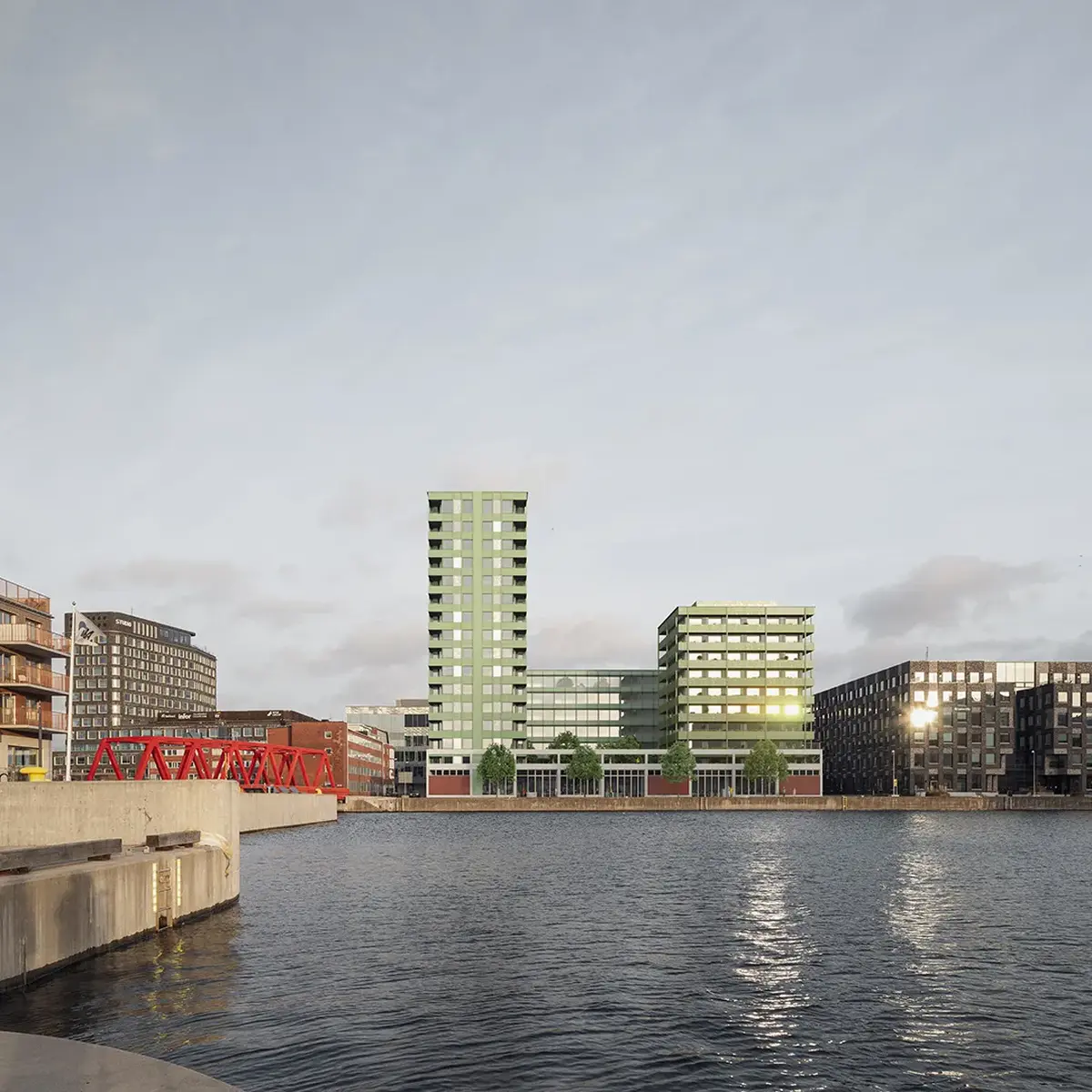
Trollhättan 6, Malmö, Sweden for Skanska Fastigheter, Riksbyggen and Malmö Stad with Kjellander Sjöberg, Förstberg Ling, We Made That, Ramboll
The re-development of the Trollhättan 6 city block into a mixed-use urban quarter in Malmö, Sweden proposes a hybrid architecture that combines both workspace and housing, while the ground floor contributes to vibrant urban life along the quayside and in the surrounding streets. The ambition of the scheme includes the careful re-use of existing elements of an office block and car park, with a bold sustainability agenda.
Describe the context of this project, its neighbourhood and people.
Trollhättan 6 occupies a prominent waterfront position along Beijerskajen at Malmö’s Southern shipyard basin, situated within the transforming Universitetsholmen district. This former port area carries significant cultural heritage as a historic freight yard where ships docked and cargo operations defined daily rhythms. The neighbourhood sits at the intersection of two major regeneration areas: Varvsstaden, the former shipyard, and Universitetsholmen, the former port. Both districts are evolving into knowledge-based communities centred around Malmö University, creating what locals describe as a blue campus within Sweden’s emerging knowledge city. New pedestrian connections, bridges and pathways are integrating the water space of the quay into central Malmö’s wider urban fabric, whilst public realm improvements have introduced green areas and places for enjoyment. The community includes university students, academic staff, creative professionals, and established residents adapting to the area’s transformation from industrial heritage to contemporary urban living. The site’s maritime character remains visible through existing infrastructure and neighbouring developments that reference the area’s shipbuilding legacy. Local identity emerges from the interplay between industrial heritage and contemporary Scandinavian urbanism, where weathered materials and robust building forms reflect both historical function and modern sustainability ambitions.
Please describe your approach to this future place and its mix of uses. How will it function as a vibrant place? How does it knit into and serve the needs of the wider area?
Our approach centres on creating a hybrid architecture that seamlessly integrates workplaces, housing and services through carefully considered ground floor activation. The design connects Nordenskiöldsgatan to the quayside, supporting pedestrian flow between the neighbourhood’s urban fabric and waterfront amenity. Styrmansbron – a new bridge for pedestrians, cyclists and public transport designed by Kjellander Sjöberg – also connects central Malmö to the emerging district. Vibrancy around buildings emerges through strategic programming: commercial spaces with double-height ceilings will accommodate independent businesses, whilst flexible middle sections facing the quay can house restaurants or cultural venues. Residential entrances are separated to maintain distinct identity, with ground-level corner premises enabling live-work opportunities. A structure of vacant former office spaces and under-used car parking will become a hive of activity, supporting residential communities and networks of thriving offices. The elevated green courtyard, positioned on the upper former parking deck, provides shared outdoor space for residents and workers whilst framing views over the quayside. This communal asset strengthens social connections across different user groups and extends the public realm vertically. Integration with the wider area occurs through sensitive massing that responds to Nordenskiöldsgatan’s scale through considered setbacks, whilst harbourside volumes create a graduated transition to the water. The design knits into the emerging blue campus context by providing essential mixed-use services that support the university community whilst contributing to broader urban life. Robust spatial design ensures adaptability over time, allowing commercial and community functions to evolve with changing neighbourhood needs whilst maintaining foundational infrastructure for long-term viability.
What is the social and environmental impact of the project? For example, how will the carbon use and material impact of the development be mitigated? What is the sustainability strategy? How will this future place contribute to the economic, environmental and social wellbeing of its citizens?
Environmental impact mitigation centres on radical resource conservation through adaptive reuse of existing building components. The sustainability strategy prioritises what already exists: preserving structural elements, building volumes and aesthetic character to minimise new material requirements and avoid additional foundation construction. Environmental impact mitigation follows rigorous carbon reduction targets established through LFM30 (Local roadmap for climate-neutral building and construction sector in Malmö 2030) and Skanska Fastigheter’s net zero commitment by 2037. The project targets ambitious embodied carbon performance: 166 kgCO2e/m² GFA for residential components and 170 kgCO2e/m² GFA for office space. The UK average for homes in 2022 was 640 kgCO2e/m2 — so Trollhättan 6 is demonstrating solutions with 26% of the embodied carbon compared with the UK average. New building components undergo careful selection based on renewability criteria and embodied carbon performance. The facade strategy employs available materials including recycled sheets, corrugated panels and newly produced smooth surfaces, creating aesthetic coherence whilst maximising resource efficiency. Social wellbeing emerges through mixed-use programming supporting diverse community needs: affordable workspace within the knowledge district, residential options near Malmö University, and flexible ground floor spaces enabling local entrepreneurship. The shared elevated courtyard provides essential communal outdoor space whilst strengthening social connections across user groups. Economic benefits include supporting local business establishment through adaptable commercial spaces and contributing to knowledge economy transformation. Environmental integration with green public realm improvements enhances urban biodiversity corridors whilst water space activation creates recreational amenity for broader community benefit.
Sign up to our newsletter
Get updates from The Developer straight to your inbox
Thanks to our organisation members
© Festival of Place - Tweak Ltd., 124 City Road, London, EC1V 2NX. Tel: 020 3326 7238