Get updates from The Developer straight to your inbox Yes, please!




Southbank, Bratislava, Slovakia for Penta Real Estate with Studio Egret West, Snøhetta, Gro Arkiteki and Pantograph
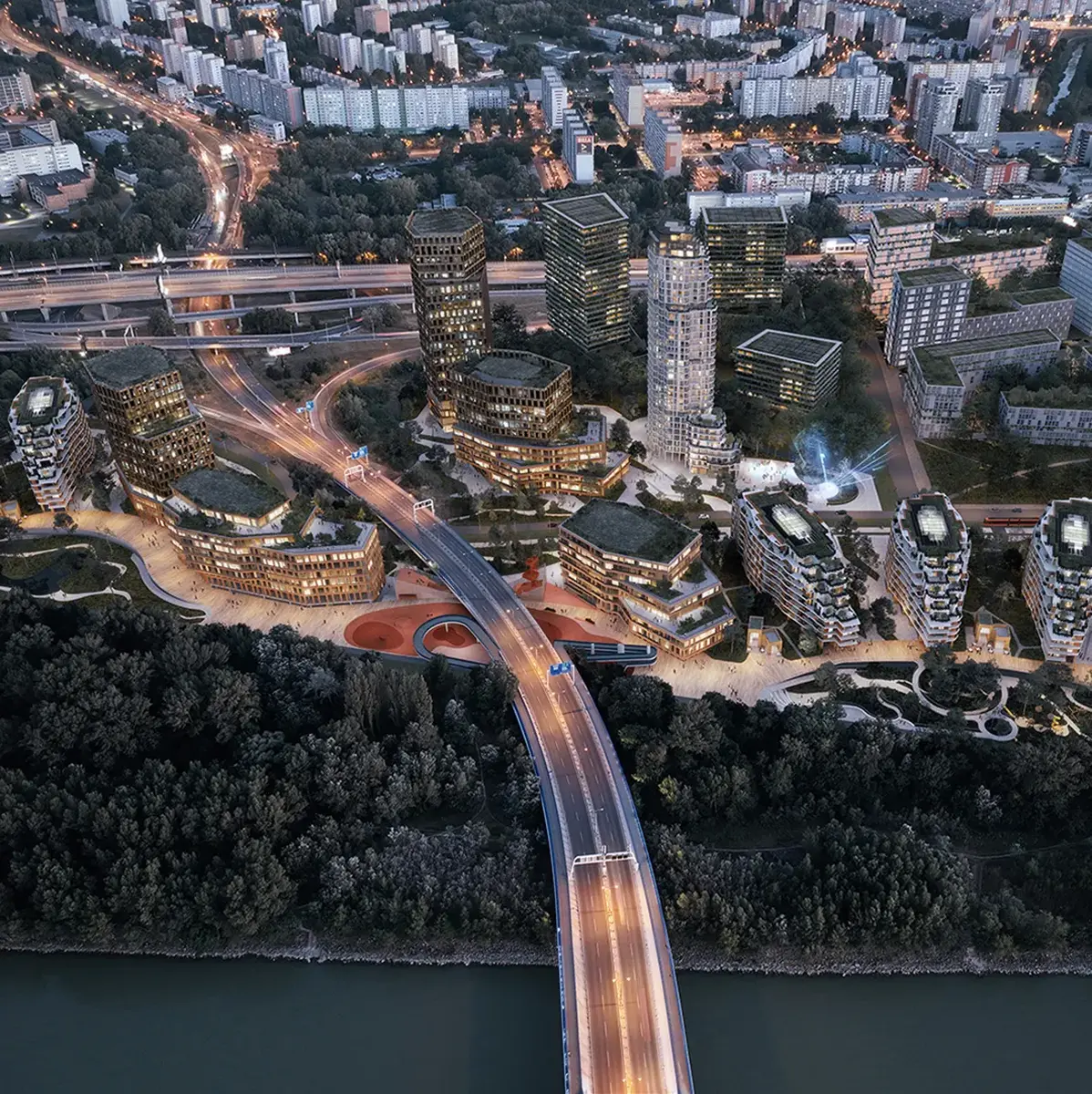
Southbank, Bratislava, Slovakia for Penta Real Estate with Studio Egret West, Snøhetta, Gro Arkiteki and Pantograph
Southbank Bratislava reimagines the Danube’s southern bank as a dynamic mixed-use district with a balanced blend of homes and workplaces, the masterplan is carved into five distinctive ‘bowls’ of activity and ecology, all linked by an activated central boardwalk. Residential buildings embrace organic, terraced forms, while workplace clusters step up to create a striking gateway to the city. Inspired by eroded riverbanks, this sustainable neighbourhood offers culture, amenity, and thriving public spaces for a new urban community.
Describe the context of this project, its neighbourhood and people.
Southbank Bratislava occupies a strategic position on the southern banks of the River Danube, directly opposite the Historic City Centre and the emerging downtown. Long identified as a key part of Bratislava’s ambition to grow as a “City by the River”, this stretch between the Apollo and Prístavný bridges offers one of the city’s most significant regeneration opportunities. The 210,000 square metre masterplan establishes a compact, well-connected new district with a balanced mix of 48 percent residential and 52 percent workplace uses supported by active ground floors and a generous public realm. The neighbourhood is designed for a diverse, multi-generational community. Families benefit from a nursery and generous public spaces, including the Play Bowl and Tranquillity Bowl, while a bike workshop café, cultural venue and an animated riverfront boardwalk contribute to everyday social life. A publicly accessible rooftop on the landmark tower reinforces inclusivity and connection to the city. Bratislava’s broader context also shapes the project. To the south lies Petržalka, the city’s largest borough, highlighting opportunities to improve connections across major road infrastructure. The Danube banks themselves hold deep historical significance, having long served as a route for trade, movement and settlement from Celtic and Roman times through the medieval and Habsburg periods. Although the development site lacks built heritage, it is defined by a resilient natural landscape that has endured despite urbanisation.
Please describe your approach to this future place and its mix of uses. How will it function as a vibrant place? How does it knit into and serve the needs of the wider area?
Southbank Bratislava occupies a strategic position on the southern banks of the River Danube, directly opposite the Historic City Centre and the emerging downtown. Long identified as a key part of Bratislava’s ambition to grow as a “City by the River”, this stretch between the Apollo and Prístavný bridges offers one of the city’s most significant regeneration opportunities. The 210,000 square metre masterplan establishes a compact, well-connected new district with a balanced mix of 48 percent residential and 52 percent workplace uses supported by active ground floors and a generous public realm. The neighbourhood is designed for a diverse, multi-generational community. Families benefit from a nursery and generous public spaces, including the Play Bowl and Tranquillity Bowl, while a bike workshop café, cultural venue and an animated riverfront boardwalk contribute to everyday social life. A publicly accessible rooftop on the landmark tower reinforces inclusivity and connection to the city. Bratislava’s broader context also shapes the project. To the south lies Petržalka, the city’s largest borough, highlighting opportunities to improve connections across major road infrastructure. The Danube banks themselves hold deep historical significance, having long served as a route for trade, movement and settlement from Celtic and Roman times through the medieval and Habsburg periods. Although the development site lacks built heritage, it is defined by a resilient natural landscape that has endured despite urbanisation.
What is the social and environmental impact of the project? For example, how will the carbon use and material impact of the development be mitigated? What is the sustainability strategy? How will this future place contribute to the economic, environmental and social wellbeing of its citizens?
Southbank Bratislava is founded on a comprehensive sustainability strategy that prioritises environmental resilience, low-carbon design and long-term social value. Its approach is guided by principles aimed at achieving a low-to-zero-carbon development, supported by Life Cycle Assessment analysis and climate simulations that inform decisions on materials, building systems and spatial configurations. Passive design plays a central role, with building placement and massing optimised to minimise solar heat gain, maximise natural ventilation and reduce operational energy demand. On-site energy production and circular resource strategies, including recycling and up-cycling, further drive down environmental impact. A nature-first methodology shapes the masterplan. The landscape bowls retain stormwater, generate microclimates and provide generous activity spaces for all age groups. Water management integrates recycling, retention and natural filtration, reinforcing a resilient ecological framework across the site. Blue-green infrastructure strengthens this, weaving natural water systems and green spaces through the urban fabric to improve stormwater management, reduce flood risk, enhance water quality and support groundwater recharge. It also contributes to cooling, mitigating heat-island effects and creating comfortable, healthy environments. Tree protection is a core component of environmental stewardship. High-value trees were identified early, incorporated into the design and safeguarded through designated root zones, construction protocols and specialist monitoring. Social wellbeing is equally prioritised. The district is designed as a multi-generational neighbourhood with a nursery, cultural and leisure spaces, a bike-workshop café, a publicly accessible rooftop and a vibrant boardwalk. Walkable streets, cycle routes and strong public transport links support active lifestyles and low-carbon mobility.
Sign up to our newsletter
Get updates from The Developer straight to your inbox
Thanks to our organisation members
© Festival of Place - Tweak Ltd., 124 City Road, London, EC1V 2NX. Tel: 020 3326 7238