Get updates from The Developer straight to your inbox Yes, please!




Central Foundation Boys' School, London Borough of Islington for Central Foundation Boys' School with Hawkins\Brown, BDP and Gardiner & Theobald
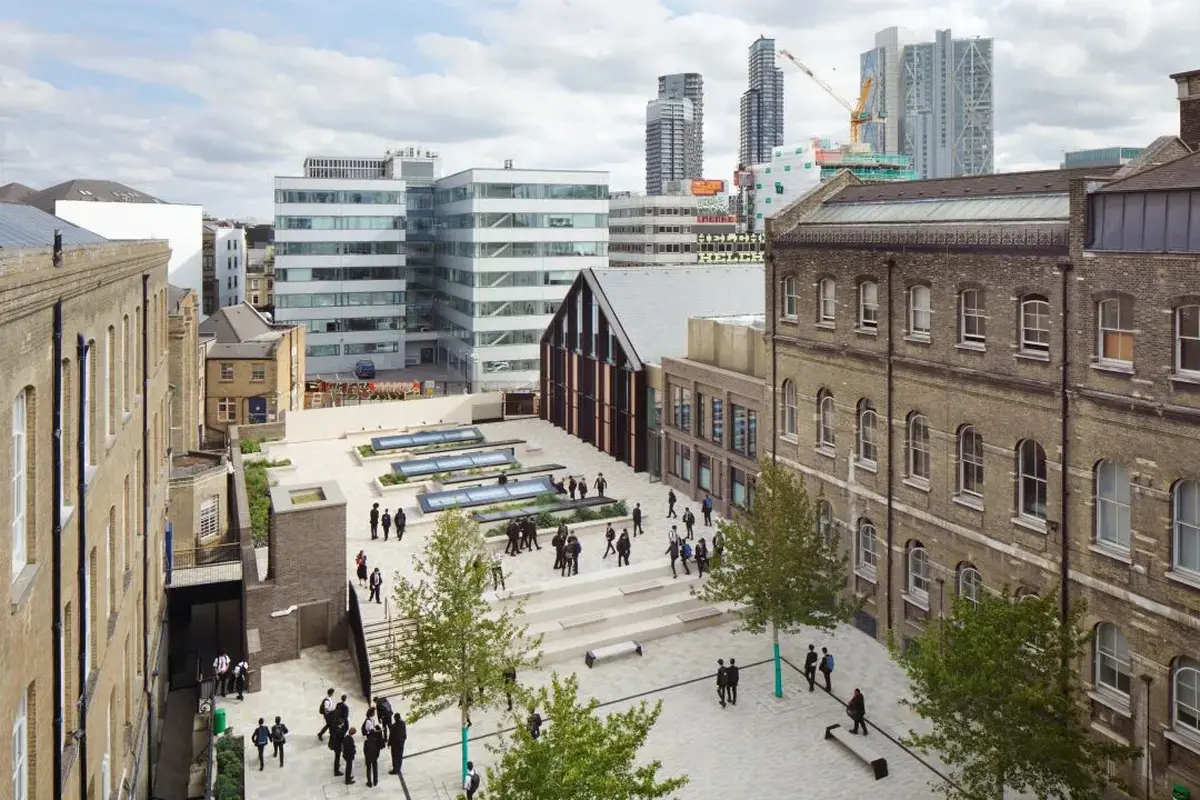
Central Foundation Boys’ School, London Borough of Islington for Central Foundation Boys’ School with Hawkins\Brown, BDP and Gardiner & Theobald
Central Foundation Boys’ School, a top-performing non-selective comprehensive school, has transformed its inner-city campus, providing state-of-the-art learning facilities for students between years 7-11 and sixth form. The decade-long, phased redevelopment consolidated and modernised a fragmented campus, preserving the school’s heritage buildings while maintaining full operational capacity throughout construction.
The redevelopment of the school has not only improved educational facilities but also contributed positively to the urban environment by introducing landscaped areas and community accessible spaces.
youtu.be/XEb73uA5mUU?si=Z8aDBTEfs323K8dy&t=9422
Describe the context of this project, its neighbourhood and people.
Central Foundation Boys’ School is located in the heart of inner-city London, near Old Street Roundabout—an area marked by high urban density, poor air quality, and a rich architectural heritage. The school sits within a conservation area and is surrounded by a diverse, vibrant community. Historically, the site evolved over 150 years, incorporating seven buildings including a Grade II-listed County Court and a former Tabernacle Chapel. These structures reflect the area’s social and cultural evolution, from its roots in technical education and religious assembly to its current role in comprehensive schooling. The school has long served local families, offering high-quality education in a non-selective setting. It continues to be a vital institution for the community, educating boys from Year 7 to Sixth Form. The buildings, once occupied by various civic and religious groups, are now fully integrated into the school’s campus. The transformation has allowed the school to remain operational and relevant, preserving its legacy while adapting to contemporary educational needs. One of the campus redevelopment project aims was to create facilities that will serve not only the CFBS students and staff but also the wider community. The sports hall is used in the evenings by the Greenhouse Sports Charity and Middlesex Cricket Club and the new Theatre in the Creative Arts Centre hosts numerous events and competitions. In January 2025, London Symphony Orchestra Discovery moved into the Creative Arts Centre and will stay at Central Foundation until their permanent home at St Luke’s Church is fully refurbished.
Describe the intervention you’ve made including its purpose and motivation. Please explain the governance of the project, describing its viability and any consultation and community engagement undertaken.
The intervention at Central Foundation Boys’ School was a decade-long, phased redevelopment aimed at consolidating and modernising a fragmented campus. The purpose was to create state-of-the-art learning environments while preserving the school’s heritage buildings and maintaining full operational capacity throughout construction. Key motivations included addressing poor building conditions, improving energy efficiency, and enhancing accessibility across the site. Governance of the project involved a complex funding strategy, combining Department for Education support through the Priority School Building Programme with proceeds from a new eight-storey commercial building integrated into the masterplan. This financial model enabled the school to overcome significant budgetary constraints while delivering high-quality upgrades. Public consultation and community engagement were central to the project’s success. The school worked closely with the local planning authority and English Heritage to ensure sensitive restoration of listed buildings and alignment with conservation area requirements. The design team also engaged with school stakeholders to understand educational needs and aspirations, ensuring the new facilities reflected the school’s ethos and future vision. The intervention was not only about physical transformation but also about cultural and educational renewal. By creating a welcoming new science building, a subterranean sports hall, and a Creative Arts Centre within the former Tabernacle Chapel, the project reimagined the school’s spatial identity. These spaces now serve both students and the wider community, offering flexible, multi-use environments that support learning, recreation, and engagement beyond school hours.
How does this project make use of an existing structure, place or building in a creative way? Is it innovative? How will this project continue to evolve or enable future flexibility and adaptation? Have you considered its resilience?
The redevelopment of Central Foundation Boys’ School exemplifies creative reuse and architectural innovation. Rather than demolishing and rebuilding, the project retained and refurbished seven existing buildings, including heritage assets like the Grade II-listed County Court and the Tabernacle Chapel. This approach preserved the site’s historical character while extending the life of its structures through thoughtful, sustainable interventions. One of the most innovative aspects was the subterranean sports hall, buried 8.5 metres below the courtyard between two listed buildings. Using a top-down construction method, the team minimised disruption and cost while creating a Sport England-compliant facility. Above it, the courtyard was transformed into a landscaped playground, integrating rooflights as seating and daylight features—an elegant solution that maximised limited space. The project also demonstrated resilience and adaptability. Existing materials were salvaged and reused, and thermal upgrades were made to improve energy efficiency. The school’s piecemeal services were consolidated into a high-efficiency system, reducing emissions and operating costs. The Creative Arts Centre, housed in the formerly neglected Tabernacle Chapel, now provides a robust, characterful space for artistic expression, with exposed brickwork and minimal interventions that celebrate its original structure. Looking ahead, the campus is designed for flexibility and future adaptation. The new and refurbished spaces support evolving pedagogical needs and community use, while the infrastructure improvements ensure long-term viability. The school’s commitment to sustainability and heritage conservation positions it as a resilient educational institution, capable of thriving amid urban challenges and serving generations to come.
Sign up to our newsletter
Get updates from The Developer straight to your inbox
Thanks to our organisation members
© Festival of Place - Tweak Ltd., 124 City Road, London, EC1V 2NX. Tel: 020 3326 7238