Get updates from The Developer straight to your inbox Yes, please!




76 Southbank, London Borough of Lambeth for Wolfe Commercial Properties and Stanhope with Allford Hall Monaghan Morris, Multiplex, Heyne Tillett Steel, Watkins Payne, Vogt and Eckersley O’Callaghan
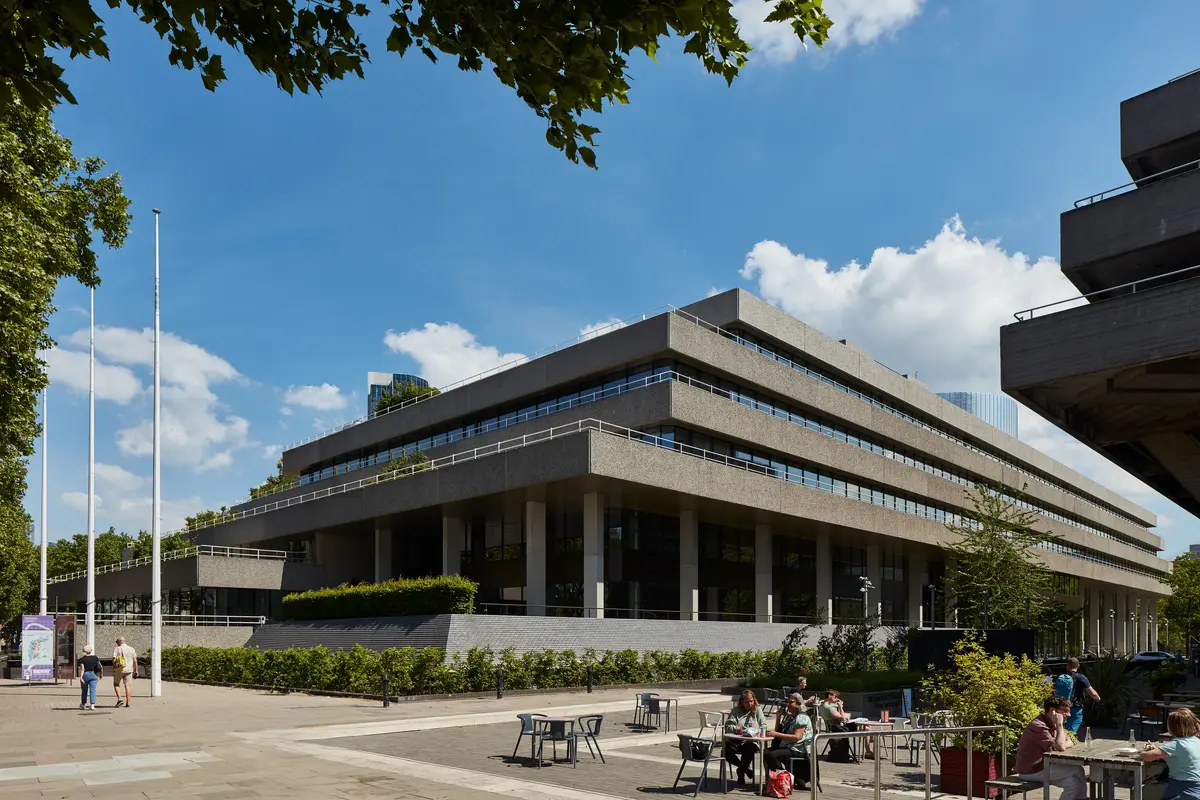
76 Southbank, London Borough of Lambeth for Wolfe Commercial Properties and Stanhope with Allford Hall Monaghan Morris, Multiplex, Heyne Tillett Steel, Watkins Payne, Vogt and Eckersley O’Callaghan
Originally designed by Sir Denys Lasdun, completed in 1983 as the office and marketing building for IBM, the project sees the careful refurbishment and extension of the Grade II listed building to deliver an additional 11,000 square metres of flexible and highly sustainable office space while preserving this important building for the long-term future. The scheme greatly enhances both the building itself and, by pedestrianising its car-orientated relationship with the public realm, its setting within the South Bank conservation area.
Describe the context of this project, its neighbourhood and people.
In 1977, IBM approached Sir Denys Lasdun to build an office and client marketing building adjacent to his now Grade II* Listed National Theatre. The brief was for 300,000sq ft building with space for 1,000 staff, areas for demonstration, conference suites, employee facilities, data processing libraries and a 25-space car park. The original building was defensive and inward looking with a vehicle ramp to a 1st floor entrance and another down to the subterranean car park in response to the car-centric nature of the South Bank at the time and the space between the two buildings being a busy servicing road. Office workers entered the building via the steep vehicle ramp, and the extensive external private terrace space was left unused due to sparse landscaping and health and safety issues. IBM remained as tenants up until 2022 when they vacated the building as it no longer met the needs of a modern-day office user in terms of flexibility, working environment, amenity, daylighting and energy. The building forms the eastern bookend of the post war cultural redevelopment of the Southbank and was listed at Grade II in 2020. AHMM and the design team have worked hard to update this important landmark building to deliver a highly efficient and flexible commercial space, replacing its car-orientated ground floor with a new publicly accessible lobby, improving the building’s relationship with the immediate public realm and river frontage, and landscaping 50,000sqft of roof terraces across all office floors.
Describe the intervention you’ve made including its purpose and motivation. Please explain the governance of the project, describing its viability and any consultation and community engagement undertaken.
The heritage significance of the IBM building and its relationship with the National Theatre were key drivers of the reinvention of this failing commercial building into a sustainable and flexible workplace. The team undertook research into the history and architectural intent of the original building, looking at the Lasdun Archive and referencing his previous design studies for the site along with correspondence with planners to demonstrate that an extension to the east and one whole new floor better matched the original composition of the pair of buildings, maintaining the hierarchy between the two. The building was stripped back to its frame and remodelled to make it fit for 21st-century office occupiers with a new open circulation core and fully accessible landscaped terraces. The domineering car ramps were carefully cut out of the building and replaced by a new street level colonnaded entrance. Collaboration with both LB Lambeth and Historic England during the pre-application stage ensured that the building was revived and its heritage significance preserved. Elements of the building which were no longer functioning in today’s more public context of the South Bank were restored and enhanced. Multiplex engaged with various local stakeholders to ensure that the works were carried out sensitively, while also providing a framework for the efficient completion of the build. Through regular engagement with the National Theatre, Coin Street, and LB Lambeth, effective and trusting partnerships were developed throughout the construction period, leaving a lasting, positive reputation for Multiplex, the wider construction industry and 76 Southbank.
How does this project make use of an existing structure, place or building in a creative way? Is it innovative? How will this project continue to evolve or enable future flexibility and adaptation? Have you considered its resilience?
The entire building was stripped back to its structural frame and through thoughtful design and engineering, 80% of the existing structure was retained saving 10,171tCO²e of carbon. Extensive research and load testing of the existing structure found the building was founded on ‘Franki’ piles. These are driven, cast-in-situ concrete displacement piles with an enlarged base. A unique foundation system was designed to re-use the piles with the additional load – justification of this was the first of its kind and extensive foundation and concrete testing was undertaken, showing that the concrete could withstand the increased load therefore reducing the number of new piles required. The structure has been designed with the capacity for change of use from office to residential and other uses in the future. The office floors have been designed to be subdivided into a number of smaller tenancies to allow for changing working habits and the MEP systems have been designed with future capacity for changes in occupancy. Two hundred pre-cast concrete cladding panels measuring 1.8x7.2m were removed from the building, refurbished and re-hung onto the extended floor slabs. 120 new panels were cast and seeded with matching granite aggregates from the same quarry as used in the original listed building. The craft of seeding concrete by hand was researched and re-learned with extensive testing and sampling. 24 tonnes of steel were reclaimed, tested and used to frame the central lift and stair core, reclaimed bricks have from the original building have been reused wherever possible.
Sign up to our newsletter
Get updates from The Developer straight to your inbox
Thanks to our organisation members
© Festival of Place - Tweak Ltd., 124 City Road, London, EC1V 2NX. Tel: 020 3326 7238