Get updates from The Developer straight to your inbox Yes, please!




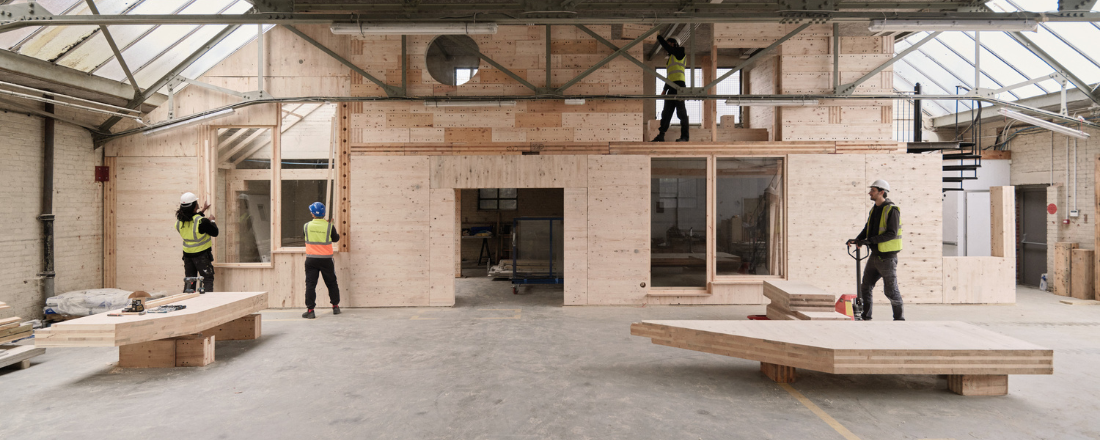
Going circular: Why London is building the largest material reuse hub in Europe
Tipping Point East in Newham aims to radically transform construction waste and supercharge reuse. Hani Salih meets the people dismantling the system and building a circular economy, one step at a time


Hani is a researcher, writer, and curator at the edge of a long list of disciplines and practices, connecting the dots between them. His
......Hani is a researcher, writer, and curator at the edge of a long list of disciplines and practices, connecting the dots between them. His
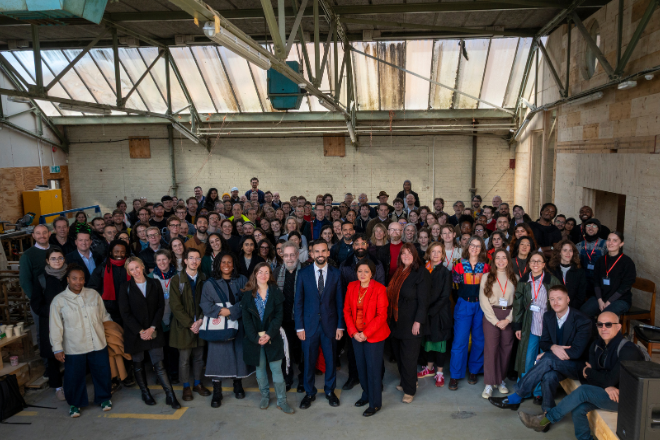
......A s we file out of the Pontoon Dock DLR station through metal gates towards an unassuming industrial estate in Newham on a sunny Monday morning, the arrival of spring has put a pep in my step. We’re all headed to the new circular material hub, Tipping Point East, which is celebrating its official opening.
Once up and running, this will be the largest material reuse hub in Europe. It marks a significant stage in London’s trajectory towards addressing climate change systematically. In the main hall, materials are stacked in neat piles behind reclaimed curved benches, while board trolleys and pallets are treated with as much attention as decorative elements.
The jubilant mood captures an undercurrent of optimism that’s hard to articulate. There are speeches from Newham mayor Rokhsana Fiaz and London deputy mayor of environment and energy Mete Çoban, plus a panel discussion including representatives from three practices working out of the centre.
Guided tours around the space give a preview of what’s to come, the aspirations rendered beautifully in the sun, punctuated by the sound of jet engines roaring overhead, so close you could count the rivets on the underbelly of the British Airways planes as they come into land at London City Airport.
“There’ve been loads of people coming out of the woodwork: construction companies, manufacturers, design organisations, local authorities and so on. This space has given the potential of circularity a place to go.”
The warehouse is divided into three sections, one for each of the hub’s three tenants: Resolve Collective, Material Cultures and Yes Make.
Resolve Collective is an interdisciplinary design group working to address social challenges through art, technology architecture and engineering. Its space is lined with its material store featuring colourful artefacts carefully sorted into broad categories, Material Cultures showcases a more restrained palette, its exposed timber elements reflecting the practice’s research focus, with an evident attention to architectural detail and disciplined use of colour, often rooted in a material’s natural finish.
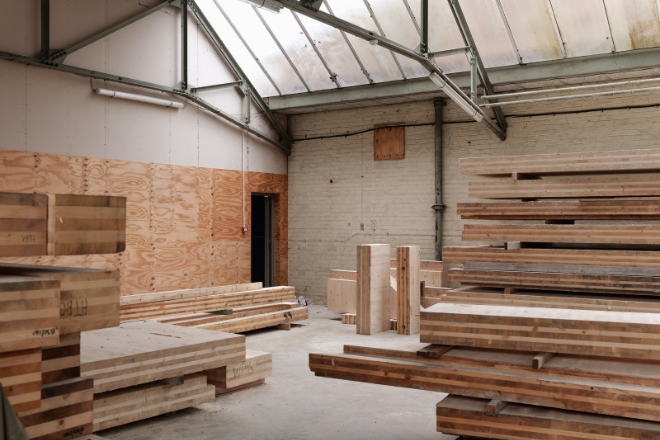
Yes Make, a material-led design-and-build collective and reuse expert, had not yet fully built out its space, but showcased a neatly organised cache of double-glazed windows, corkboard insulation and a constellation of structural timbers.
A few weeks later, returning to the industrial estate weeks after the launch, the hub still carries the same energy. I catch up with Yes Make’s founder and creative director Joel De Mowbray and ask if he’s pleased with the opening, because to me it felt like a lot of people came away feeling energised. “One-hundred per cent,” he says. “I’ve had over 400 inquiries in the four weeks we’ve been open. The appetite is through the roof.
“There’ve been loads of people coming out of the woodwork: construction companies, manufacturers, design organisations, local authorities and so on. This space has given the potential of circularity a place to go.”
De Mowbray speaks with authority and clarity about Yes Make’s mission. His no-nonsense approach seems to be rooted in a strong and genuine belief in what’s possible.
“I’m not going to wait around and spend 10 years talking about doing this,” he says. “We’re going to crack on and get it done and show people what they’re missing.”
A self-funded start-up, Yes Make has no outside investment and isn’t seeking any. De Mowbray gives me a tour through the empty warehouse that will be its material processing space. “From our perspective, I don’t really consider us to be open,” he says. “We’ve still got quite a lot of electrical fit-out left and a lot of workshop equipment needed to get this building into a safe and a usable condition.
“The 1st of July will be a big step where we’ll have the yard properly operational with a lot more structure and storage space.”
It’s a huge space too, with exposed structural elements that lend it a slightly theatrical sensibility. We find ourselves sitting on a wooden bench in the sun outside as we continue talking.
“None of what we’re doing here is really special in any way,” he says. “We move stuff. We plan how we move that stuff and we design with that stuff to reduce our dependence on virgin materials. We don’t rely on grant funding. We do a good job, we show people we do a good job and we get more jobs from it.”
De Mowbray says they’ve completed one build and are working on several more. “We’ve got a really large one-year build that we’re doing in London Bridge: Two-storey community buildings with a big canopy, a bridge, all sorts.
Tipping Point East is the first of its kind of this scale in England, but elsewhere in Europe, places like Belgium and the Netherlands are already up and running with an almost institutionalised culture of circularity.
“We’re starting to show the scale that you can reach, and we’re working towards getting to three-to-seven storey buildings and testing the capability of reused materials to provide entire dwellings, office spaces, event spaces, community spaces.”
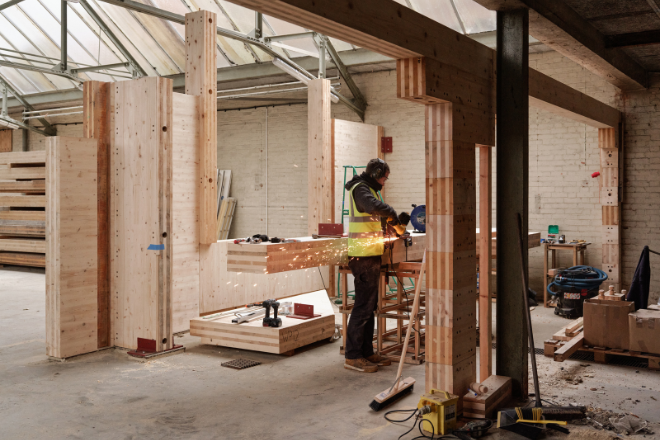
Our discussion reminds me of the conversation architects once had around the use of cross-laminated timber in taller buildings. Policy took a while to catch up and, when it did, curtailed the scale of its potential use.
De Mowbray says they are focused on the materials they can redeploy right now. “We can’t do fire doors,” he explains. “Even if a fire door was installed one year ago on a 15-year warranty, we don’t have the ability to sign it off for reuse … But we currently have 50-60 fire doors that we’re able to use [in other ways] to demonstrate that they can and should be reused.
“We still need to conform to compliance, insurance, liability, risk management, construction, health and safety requirements. The more radical aspects of environmental change tend to sit as a counterpoint to the mainstream way things currently work. Our main task is integrating that change into the existing context, so that we’re able to do that work now.”
Tipping Point East is the first of its kind of this scale in England, but elsewhere in Europe, places like Belgium and the Netherlands are already up and running with an almost institutionalised culture of circularity. I ask De Mowbray why we’re so far behind compared with other countries when it comes to circularity.
“I don’t see us as behind,” he counters. “I see us as not recognising the head start that we have. We still have a thriving distributed network of reclamation in the UK that allows us to capture those items that do fall in line with conventional reclamation and send them to where they’re needed.”
He points out that we have always reused construction materials, from reclaimed bricks and floorboards to plaster mouldings and fireplace surrounds. “If you go to an old-school reclamation yard,” he says, “you’re not going to find internal glazed partitions. You’re not going to find fire doors. Our material palate for construction has diverted so far away from modular dismantleable materials that was classic practice in the past.
“On the other hand, the circularity question of today is how do we reclaim a lot of materials that are kind of crap? I shouldn’t denigrate it as much as that, but a lot of the problem of waste, reuse and construction is that a lot of our building components are designed to be the lightest, cheapest possible way of throwing something up quickly. And that is the problem.
“In contrast, Belgium has legislation around the design teams that are involved in the development of projects to make sure that circularity is considered fundamentally within the core of the work that they do.”
While De Mowbray acknowledges that some behavioural change is needed, he’s looking for tweaks and gaps in the existing system that don’t require much effort or can be incentivised. “I think values-based behaviour change has a long old lead-in before it yields results,” he says. “But economic-based behavioural change happens overnight.”
With construction waste and recycling, there are material categories where companies pay for disposal and there are categories where they get rebates to give it away. “I would like to get to a place where we were able to offer rebates for almost all of the materials that we take, because that is a form of behaviour change that just makes it the obvious choice,” De Mowbray says.
“I can’t do rebates right now from a cashflow point of view. There’s high risk in it, and it’s speculative. However, as we get to more of a normalised approach in the industry around material circularity, we’ll have the confidence to be able to go in for rebates. We’re already starting to think about this with some material categories for which we currently have more demand than supply.”
To that end, the organisation is working on forging partnerships with some of the largest waste and recycling companies in the UK.
“These organisations deal with hundreds, if not thousands of tonnes of brand-new materials going into their skips each year,” he says. “So if we can give existing waste and recycling facilities the ability to grade and set aside materials for reuse that we take immediately, that means that every construction site is still doing exactly what they’re doing.
“A contractor cannot pull out materials if there’s no one that’s going to take them. They need to smash them and dispose of them as quickly as possible. A developer cannot put a contractor under contract to delicately and meticulously take out all these materials if they’ve got nowhere to go. This is where the systemic nature of the issue is clearest. Without the demand on our side for these kinds of materials, developers don’t have options. Contractors don’t have options. Designers and architects don’t have options. So that’s what we’re doing here is creating those options.”
De Mowbray believes the potential scale of materials they could redeploy is huge. “In London, we estimate that there’s between one and two million tonnes of materials that we could reuse,” he says. “But then, how the hell do you turn over half a million tonnes of materials?
“We’ve been in the yard since September, taking materials, sending them out, processing them, using those materials for builds, distributing them to other organisations,” De Mowbray says.
“What we’re doing is laying the carpet while we walk. I can take two or three steps ahead and we can lay that carpet as we go.”
Hani Salih is a writer, researcher, curator and educator. He has worked as a researcher for the Design Museum and the Quality of Life Foundation and was co-curator of Rotterdam’s architecture biennale in 2024
Sign up to our newsletter
Get updates from The Developer straight to your inbox
Thanks to our organisation members
© Festival of Place - Tweak Ltd., 124 City Road, London, EC1V 2NX. Tel: 020 3326 7238